UTRGV preceptor questions, answered briefly
Short answers to the questions UTRGV nursing students bring to our placement desk, each pointing to the guide that covers it in full. For anything about your own course, your course faculty and the School of Nursing have the final word.
Get your placement plan
Tell us your UTRGV program and where you live. A placement advisor replies with preceptor and site options in your community that fit your UTRGV course.
Who arranges preceptors for UTRGV NP students?
It depends on the program. For the FNP courses, UTRGV's current syllabi place the arranging with you: the Spring 2026 NURS 6305 syllabus makes each student responsible for lining up a preceptor and site, points to an approved list in Brightspace, and routes any practice missing from it through UTRGV's Clinical Request Form. The older 2023-24 graduate guide, now archived, described finding and recruiting preceptors as work shared between faculty and student.
The PMHNP certificate has two public answers. Its live June 2025 flyer mentions preceptor placement assistance without defining it, while the graduate FAQ that UTRGV has since removed (archived May 2025) said students secure their own approved site in their state of residence. DNP documents name the forms but not who finds the site, and the School assigns BSN clinical sites. Whatever your program's wording, our desk finds a willing clinician suited to your course; PMHNP placement assistance sets out the PMHNP sources.
What if the clinic I want is not on UTRGV's list?
It can still work. Only university-approved sites count, but approval can be added. You submit the Clinical Request Form, naming the facility, the person there who signs agreements and the preceptor, and UTRGV arranges an affiliation agreement, either its standard version or the facility's own. The wait runs 30 to 90 days under UTRGV's PMHNP guidelines, provided every field is right, so start early.
NURS 6347 is the course to watch: its syllabus draws sites from UTRGV's affiliated list and says the approved-site rule is followed strictly. A new preceptor at a practice that already has an agreement is simpler still, recorded on a Typhon data sheet. The Clinical Request Form guide explains both routes.
How many clinical hours does each UTRGV program need?
FNP: the catalog lists 605 hours across the three specialty courses, 45 in NURS 6347, 224 in NURS 6612 and 336 in NURS 6613, which is the whole clinical load of the post-master's certificate. MSN students add 45 hours in each of the three core courses (NURS 6305, NURS 6310, NURS 6311), per their syllabi. Adding every course gives 740 (our arithmetic), while the archived 2023-24 guide printed 800, so ask your course coordinator which total governs your plan.
PMHNP: 520 hours. The 2025-26 syllabi put 220 in NURS 6476 and 300 in NURS 6620; an older 2017 form split the same 520 as 110, 110 and 300 across three courses. DNP: clinical logs worth 100 hours are part of the NURS 8211 grade, and UTRGV publishes no DNP total. Each figure and its source is in the clinical hours guide.
Who can be my preceptor?
UTRGV's rule changes by course, so a preceptor who fits one course may not fit the next:
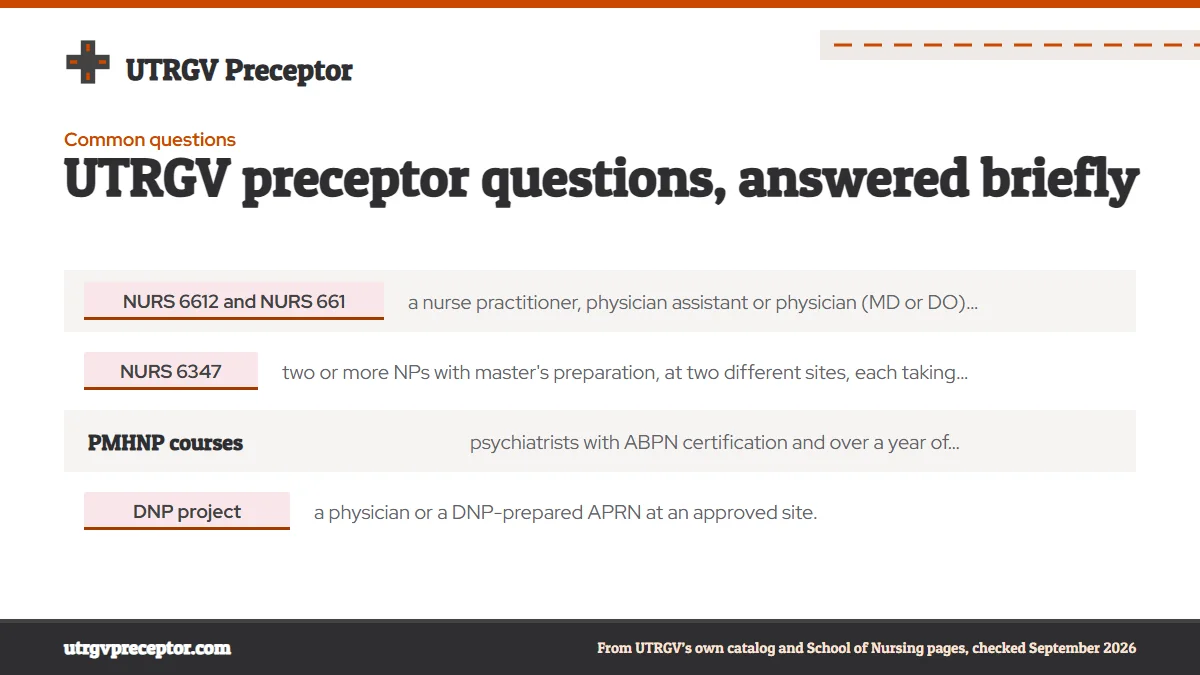
NURS 6612andNURS 6613: a nurse practitioner, physician assistant or physician (MD or DO) whom UTRGV approves.NURS 6347: two or more NPs with master's preparation, at two different sites, each taking one student.- PMHNP courses: psychiatrists with ABPN certification and over a year of post-residency practice, or PMHNPs certified by the ANCC, never at the place you work.
- DNP project: a physician or a DNP-prepared APRN at an approved site.
Texas adds its own definition of a qualified preceptor: an active, unencumbered license, current practice in the specialty, and someone who supervises, teaches and evaluates you. The preceptor requirements page covers each rule and its source.
When should I start looking?
A semester before the course opens is a sound target. A new affiliation agreement can take 30 to 90 days, FNP paperwork is due a week ahead of your first clinic day, and PMHNP students wait for their clinical faculty to clear the site before logging anything. Starting early also gives you a choice of schedules rather than whatever is left.
The courses set the calendar. On UTRGV's published 2019 program of study, FNP I and II fill the last fall and spring of the MSN, and NURS 6347 sits in a summer term. PMHNP hours begin in the fall after a Summer I start. If your course is close and you have no preceptor, go to no preceptor yet.
Can my clinicals be outside the Valley, or outside Texas?
Outside the Valley, often yes; outside Texas depends on the program. The FNP programs require a Texas RN license and meet weekly in Edinburg, which keeps FNP clinicals in Texas as a practical matter; no written UTRGV rule confines them there. A site in Laredo, Corpus Christi or San Antonio can work if UTRGV approves it and your class days allow the drive.
PMHNP certificate hours happen where the student lives. California is the one state missing from UTRGV's state authorization list, and some states set their own rules for programs based elsewhere. DNP students carry out their project at an approved site that UTRGV's documents do not tie to a state. See PMHNP clinicals outside Texas.
What does your placement desk do, and what stays with UTRGV?
We find and check; UTRGV decides. Our placement desk looks for willing preceptors near you who suit your course's rule and weekly load, trying UTRGV's affiliated practices first, verifies each candidate's license and patient mix, and collects what UTRGV's forms need, from the preceptor's data sheet to the facility contact for a new agreement. If a preceptor steps back, we start the next search straight away.
UTRGV's faculty approve every site and preceptor, clear you to start, grade your clinical work and set every rule on this page. You keep Typhon, your compliance documents and your weekly logs current. How it works shows our steps, and cost explains how a quote is built.
Questions UTRGV students ask
Can I do my clinical hours at my own workplace?
Not in the PMHNP certificate, where the archived graduate FAQ barred a practicum at the student's place of employment. UTRGV's public FNP documents are silent on the question, so check with your course coordinator before planning around your employer's clinic. A different unit in the same organization is a question for your faculty too.
Can the same clinical hours count toward two courses?
No. Per the FNP syllabi, an hour logged for one clinical course may not also be claimed for a second course running the same term, and the PMHNP FAQ said hours from an earlier program do not carry over. Texas rules also call for non-duplicated hours. Plan each course's hours on its own; rules for counting hours has the detail.
Do I need Typhon before my first clinical course?
Yes. UTRGV's MSN uses Typhon to track clinical hours for accreditation and progression, and each student pays for access a single time, good for the full program. PMHNP students record hours there as well, and the data sheets for preceptors new to UTRGV are Typhon forms. Have it set up before your first clinic day.
Can I finish my clinical hours early?
Only with approval arranged in advance. The NURS 6612 syllabus allows completing hours ahead of schedule only for a legitimate reason and with the course coordinator's prior approval, and the course is built around a steady 16 hours a week. Ask before you add extra shifts, not after.
How many telepsychiatry hours count in the PMHNP certificate?
Two UTRGV documents give different caps: 75 of 520 hours in the archived graduate FAQ, and 220 of 520 in the Spring 2026 NURS 6620 syllabus. The syllabus is more recent, but confirm the cap with your clinical faculty before you plan around it. The telepsychiatry guide compares the two.
Does UTRGV find clinical sites for BSN students?
Yes. BSN clinical placements are assigned by the School of Nursing, and generic BSN students train in local hospitals around the Brownsville and Edinburg campuses. The preceptor search begins later, once you move into the MSN-FNP. The BSN clinicals guide covers the bachelor's side.
Related pages
Last checked 2026-09-27
We check these pages against UTRGV's own catalog, course syllabi, School of Nursing pages and Texas Board of Nursing rules. Your course faculty and the School of Nursing have the final word.
From the approved list or a brand-new site, we find the preceptor who fits.
Tell us your UTRGV program, where you live and when your next clinical course starts. We line up a willing preceptor who fits the course and UTRGV's rules, and hand you the details the Clinical Request Form, the affiliation agreement and the preceptor agreement ask for, well before the semester.
- Family practice preceptors for
NURS 6612andNURS 6613, and two NP sites forNURS 6347 - Board-certified psychiatric preceptors for
NURS 6476andNURS 6620, in your home state - Across the Valley and Texas, from McAllen and Brownsville to San Antonio, Houston and beyond
- A replacement lined up fast if a preceptor drops
Start your placement plan
Program, city and start date is all we need to begin.