UTRGV's post-master's FNP certificate: three courses, 605 hours
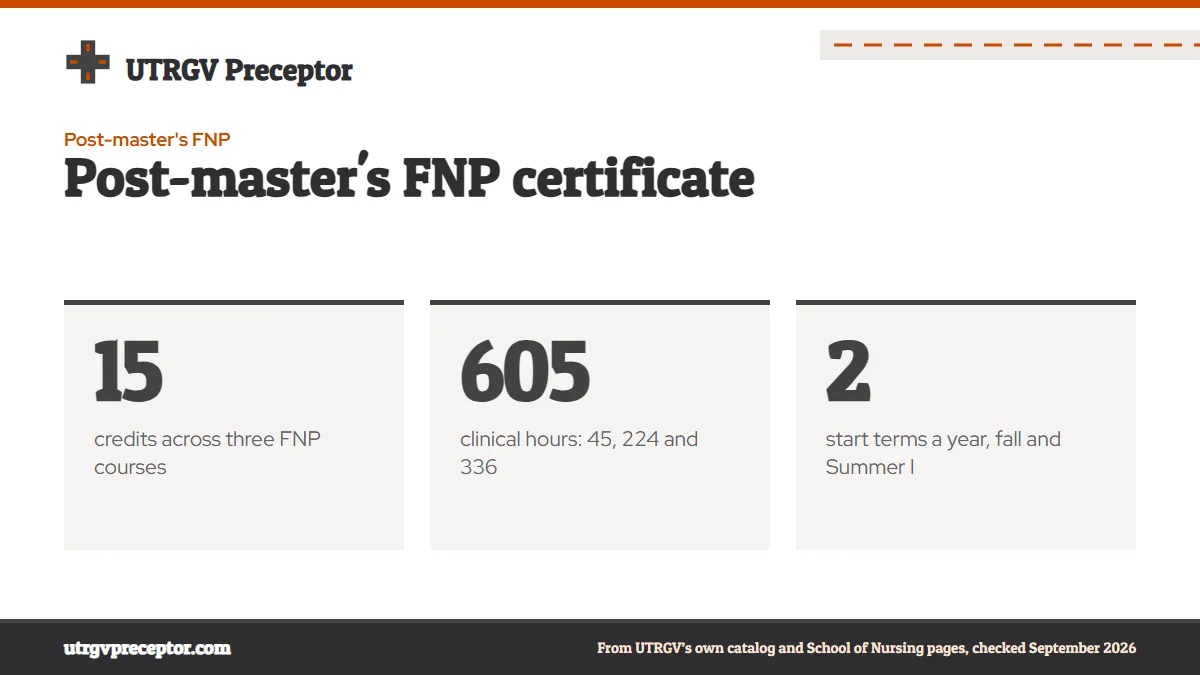
UTRGV's post-master's FNP certificate adds the family nurse practitioner specialty to a nursing master's or doctorate in 15 credits: NURS 6347, NURS 6612 and NURS 6613. Those three courses hold 605 clinical hours between them, taught campus-based in 16-week semesters, with starts in the fall and in Summer I. Because nearly every credit comes with precepted hours, your preceptor plan is effectively your program plan.
Get your placement plan
Tell us your UTRGV program and where you live. A placement advisor replies with preceptor and site options in your community that fit your UTRGV course.
Three courses, 15 credits
The catalog describes the certificate as three courses that belong only to the FNP specialty, the same three the MSN-FNP uses for its practice block. What it leaves out is the MSN's 30-credit core: instead, you arrive with health assessment, pharmacology and pathophysiology from your earlier program, as the admission rules below explain.
| Course | Credits | Clinical hours | Focus |
|---|---|---|---|
NURS 6347 Role Development for the Nurse Practitioner | 3 | 45 | The five roles of the advanced practice nurse |
NURS 6612 Family Nurse Practitioner I | 6 | 224 | Assessing, diagnosing and managing everyday acute and long-term conditions in children and adults |
NURS 6613 Family Nurse Practitioner II | 6 | 336 | Common primary care problems, with more responsibility as preceptors and faculty confirm your competence |
| Total | 15 | 605 | Also the total in the archived 2023-24 Graduate Nursing Student Guide |
One catalog detail deserves a question early. The course pages list MSN core courses as prerequisites: NURS 6310 for the role course, and NURS 6311 together with NURS 6347 for FNP I. UTRGV does not say how those apply to a post-master's student, so raise it when you receive your gap analysis. The clinical hours guide compares the certificate's 605 hours with the MSN's figures.
Campus-based, in 16-week semesters
UTRGV gives the certificate's mode of delivery as campus-based, in 16-week semesters. Its courses are the MSN's own, and those meet in Edinburg: the Fall 2025 NURS 6612 syllabus holds class in the Health Affairs Building East, where students also hand in the Mandatory Weekly Time Report at each Wednesday session. An archived 2022 version of the certificate page described a blend of traditional and online delivery, so ask how much of each course meets in person in your year.
Clinicals follow the classroom in practice. The certificate requires a Texas RN license and draws its sites from UTRGV's own affiliation list, so plan on Texas placements, though UTRGV has published no written rule limiting FNP clinicals to Texas. Within Texas, any site UTRGV approves can host your hours, from the Valley to the Panhandle.
Start terms and timing
The certificate is the only UTRGV graduate nursing program with two intakes a year. The graduate application deadlines table gives April 1 for a Summer I start and July 1 for a fall start, the fall date extended to July 31. UTRGV does not state how long the certificate takes, and it publishes no certificate plan of study.
The MSN's 2019 plan is the nearest guide: it places NURS 6347 in a summer, with FNP I and FNP II in the fall and spring that follow, a pattern that fits a Summer I start neatly. If you start in the fall, ask which course comes first, since that published sequence opens the specialty in summer.
Summer timing is tight. In 2027, Summer I runs June 7 to July 13, and Summer III, which the calendar treats as part of Summer I, runs June 7 to August 20. UTRGV does not say which session the role course uses, and its 45 hours with two preceptors have to fit inside it. The academic calendar guide lists every 2026-27 term.
Admission, gap analysis and course waivers
Admission rests on your earlier education and your license. The catalog asks for:
- A master's or doctorate in nursing from a CCNE-accredited program
- Advanced health assessment, pharmacology and pathophysiology courses equal to
NURS 6305,NURS 6306andNURS 6304, taken within the last three years - A current, unencumbered Texas RN license in good standing
- A GPA of 3.0 or better on a 4.0 scale
Two further lines decide what you actually take. Some applicants need added coursework, set by a gap analysis of their transcript. And certified APRNs who practice as adult, women's health, pediatric or acute care nurse practitioners may have courses waived. The catalog does not spell out which courses, so get your own waivers confirmed in writing when you are admitted.
Small naming differences can confuse a transcript review: the certificate entry calls the prerequisites Advanced Physical Assessment and Advanced Pharmacology, while the course pages title them Advanced Health Assessment and Pharmacology for Advanced Practice Nursing. They are the same courses.
License, clearance and Typhon
Every certificate student needs a Texas RN license, whatever state they live in. UTRGV does not say whether a multistate compact license issued by another state meets that line, so ask before you apply. Texas has been in the Nurse Licensure Compact since January 1, 2000, and the RN license guide explains how the compact works for UTRGV students.
The catalog lists a cleared criminal background check at admission and evidence of current immunizations. The FNP course syllabi add the clinical clearances: HIPAA training with its certificate uploaded to Brightspace before any clinical day, a signed confidentiality statement and student liability insurance, which NURS 6613 lists among its required forms. You also buy Typhon access, where your encounters and hours are logged and your preceptors' data sheets are filed.
Preceptors for the three courses
Certificate students follow the MSN-FNP's preceptor process. The current syllabi place the arranging with the student, starting from the approved preceptors and affiliated sites posted in Brightspace (D2L); a site outside that list needs the Clinical Request Form and a new affiliation agreement first. The archived 2023-24 guide described recruiting preceptors as work for faculty and students together. Each course wants something different:
NURS 6347: 45 hours, no more than 8 a day, with at least two master's-prepared NPs at two separate sites, one student per preceptor, and university-approved sites only. See the role course guide.NURS 6612: 224 hours, about 16 a week across two 7-week rotations, with a qualified and approved NP, PA or physician who sees children and adults. See the FNP I guide.NURS 6613: 336 hours, about 24 a week, with more of each patient's management handed to you as your competence is confirmed. See the FNP II guide.
If you already practice as an APRN, colleagues may be glad to precept, but their site still has to be on UTRGV's list, or cleared through a new agreement, before an hour there counts.
The one-student-per-preceptor rule in NURS 6347 is easy to miss: two classmates cannot share one NP, and a single NP at a single site covers only half of what the role course requires.
How we help certificate students
The certificate runs its three clinical courses back to back, so the lead time on a new affiliation, 30 to 90 days in UTRGV's PMHNP guidelines, shapes everything. We work backward from your start term and have preceptors confirmed before each course begins.
- Two master's-prepared NPs at two different sites for the role course, each agreeing to take one student.
- A family practice preceptor for FNP I who can host you at 16 hours a week and, where possible, continue at 24 hours for FNP II.
- The facility name, the person who signs agreements for it and the preceptor's details, gathered for the Clinical Request Form so the affiliation starts at once.
- The preceptor agreement, course objectives, Mandatory Weekly Time Report and Typhon data sheets ready to sign.
- A backup search that starts the day a preceptor's plans change.
Your course coordinator and clinical faculty approve every site. We make that review quick by sending a complete, well-matched request early. Tell us your start term through the placement request form.
Questions UTRGV students ask
How long does the UTRGV post-master's FNP certificate take?
UTRGV publishes no length. The three courses are chained by prerequisites, with NURS 6347 before FNP I and FNP I before FNP II, so by our reading they need at least three terms. Any extra coursework from your gap analysis adds to that. Ask the program for your own plan of study when you are admitted.
Is UTRGV's post-master's FNP certificate offered online?
UTRGV lists it as campus-based, in 16-week semesters, and the FNP courses hold class in Edinburg. An archived 2022 page mentioned some online delivery, so ask about the current mix. If you need a fully online certificate for a different specialty, the PMHNP certificate guide covers UTRGV's psychiatric option.
Can clinical hours from my first NP program count toward the certificate?
The certificate entry says nothing about carrying hours over, and each of the three courses sets its own hour requirement. Texas Board of Nursing rules require at least 500 clinical hours for post-master's students and say those hours may not be waived. Plan on logging the full 605 in Typhon unless the program tells you otherwise in writing.
Can I start the FNP certificate in the spring?
No spring entry appears in UTRGV's graduate deadlines table; the certificate lists only fall and Summer I. Miss the April 1 Summer I date and the next opening is fall, with its July 1 deadline and extension to July 31. We can begin mapping preceptors as soon as you know which term you are aiming for.
Is the post-master's FNP certificate accredited?
Yes, through CCNE. UTRGV's accreditation page names its BSN, MSN and DNP programs along with its post-graduate APRN certificate programs, and the FNP certificate is one of those two post-master's certificates. The certificate's own admission rules mirror that: your earlier master's or doctorate must come from a CCNE-accredited nursing program.
Related pages
Last checked 2026-09-27
We check these pages against UTRGV's own catalog, course syllabi, School of Nursing pages and Texas Board of Nursing rules. Your course faculty and the School of Nursing have the final word.
- UTRGV graduate catalog 2026-27: Post Master's Family Nurse Practitioner Certificate
- UTRGV School of Nursing: Academic Programs (mode of delivery)
- UTRGV Graduate College: application deadlines
- UTRGV graduate catalog 2026-27: NURS 6347 Role Development for the Nurse Practitioner
- Texas Board of Nursing: Rules and Regulations, December 2024 (22 TAC 219)
From the approved list or a brand-new site, we find the preceptor who fits.
Tell us your UTRGV program, where you live and when your next clinical course starts. We line up a willing preceptor who fits the course and UTRGV's rules, and hand you the details the Clinical Request Form, the affiliation agreement and the preceptor agreement ask for, well before the semester.
- Family practice preceptors for
NURS 6612andNURS 6613, and two NP sites forNURS 6347 - Board-certified psychiatric preceptors for
NURS 6476andNURS 6620, in your home state - Across the Valley and Texas, from McAllen and Brownsville to San Antonio, Houston and beyond
- A replacement lined up fast if a preceptor drops
Start your placement plan
Program, city and start date is all we need to begin.