Clinical compliance for UTRGV graduate nursing students
UTRGV publishes three compliance items for its graduate nursing students: a cleared criminal background check, the School of Nursing's immunization verification form, and student liability insurance whenever a course puts you in contact with patients. FNP syllabi add HIPAA training and a signed confidentiality statement, and each clinical site can layer its own onboarding on top. A graduate drug screen, a CPR rule and a compliance tracker are not published, so ask before you assume the BSN's rules apply to you.
Get your placement plan
Tell us your UTRGV program and where you live. A placement advisor replies with preceptor and site options in your community that fit your UTRGV course.
The checklist, item by item
Here is what UTRGV's catalog, public syllabi and School of Nursing forms ask of a graduate student before clinical hours begin. Each item has a section below.
Before your first clinical hour
- Cleared criminal background check. An admission requirement for the MSN-FNP, the post-master's FNP certificate and the PMHNP certificate.
- Verification of Immunization Compliance form. The School of Nursing's own form, signed by a health care provider.
- Student liability insurance. Required in any course with a clinical component involving patient contact, and billed through registration.
- HIPAA compliance training. The Fall 2025
NURS 6612syllabus requires the certificate, earned through a course in Brightspace, before any clinical work. - Statement of Confidentiality. Every syllabus carries one, citing section 217.11 of the Texas Nursing Practice Act, and you sign it before your first rotation.
- A current RN license. Texas for both FNP programs; the PMHNP and DNP rules are on the RN license page.
- The site's own onboarding. Whatever the hospital or clinic asks of its students, on its own timeline.
Criminal background check: seven years, kept while you stay enrolled
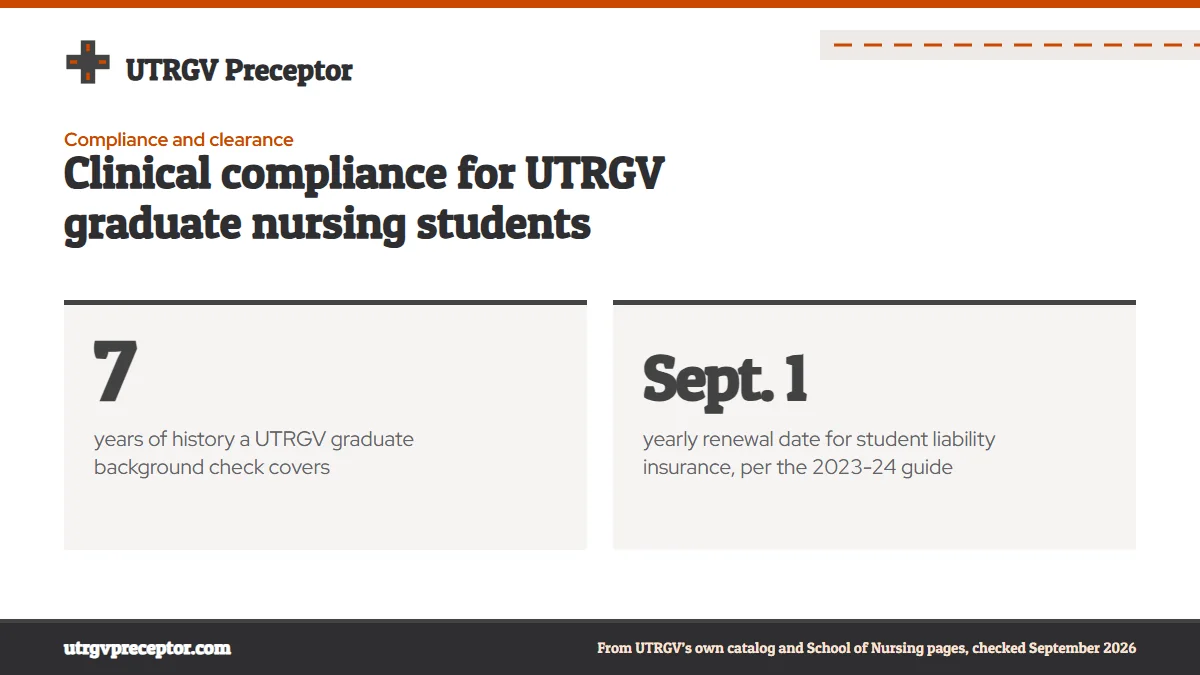
The 2026-27 catalog lists a cleared criminal background check among the admission requirements for the MSN-FNP, the post-master's FNP certificate and the PMHNP certificate. The archived 2023-24 Graduate Nursing Student Guide explains the rule behind it: UTRGV's Graduate College requires checks of newly admitted and currently enrolled students in several programs, graduate nursing among them, and each check looks back over the last seven years.
The same guide says a check is "honored for the duration of the student's enrollment in the designated program provided there is no break in enrollment." One check can carry you through the program if you enroll every term. Sit out a semester and that protection lapses, so expect to be asked for a new check when you return.
UTRGV does not publish the vendor or the ordering steps. The guide refers students to the university's Handbook of Operating Procedures, but the current handbook index lists only an employee background-check policy. Your admission materials or the School of Nursing's graduate office are the places to ask.
Immunizations on the School of Nursing's form
The catalog asks for evidence of the immunizations the Texas Department of Health requires of students in health-related programs. The School of Nursing turns that into a one-page Verification of Immunization Compliance form, still live on the Graduate College site and dated 2015. It names the MSN-FNP and the post-master's PMHNP certificate among the programs it covers, and a health care provider must sign it.
| Item | What the form asks for | How often |
|---|---|---|
| MMR | Two doses | Once |
| Varicella | Two doses, or a titer or history of the illness | Once |
| Hepatitis B | A three-dose series, or a signed waiver | Once |
| Tdap | A dose within the last 10 years | Every 10 years |
| Meningococcal | Whatever the university's own rule requires | Per university rule |
| TB test | A test every year, plus a chest X-ray every two years if the test is positive | Yearly |
| Influenza | A dose every year | Yearly |
The yearly items are the ones that cause trouble. MSN-FNP clinical hours stretch across several terms, from the 45-hour pieces of the core courses through NURS 6613, so a TB result or flu shot can expire in the middle of a rotation. Set reminders for both renewal dates as soon as the form is filed, and keep your own signed copy for any site that asks to see it.
Student liability insurance
The MSN-FNP catalog entry makes student liability insurance mandatory in any course with a clinical component that involves patient contact. It is not something you buy on the open market: the fee for the student program policy is charged in the fall semester for the whole academic year and added to your registration fees. The archived 2023-24 guide gives the renewal date as September 1 each year.
The Spring 2026 NURS 6613 syllabus lists "Student Liability Insurance 2025-2026" among its required clinical forms, beside the preceptor agreement and the weekly time report. Keep the current year's certificate where you can hand it to a site coordinator or preceptor, and check that its academic year matches the term you are in.
The catalog wording sits in the MSN-FNP entry. PMHNP and DNP students should confirm with their program how the policy is billed for them.
What a clinical site may add
UTRGV's list sets the minimum. The hospital or clinic that hosts you runs its own student onboarding, separate from UTRGV's. A site new to UTRGV also needs an affiliation agreement, started through the Clinical Request Form, and processing can take 30 to 90 days.
UTRGV's own BSN pages show the pattern. They tell students that some clinical partners use onboarding platforms like CB-Bridges or My Clinical Exchange, and that a facility may require a COVID-19 vaccine even though UTRGV does not. A graduate site can keep a list of its own too, so ask for it the moment a preceptor says yes.
PMHNP students have one more gate. The assigned clinical faculty member must clear the site before hours start, a week-one step in the NURS 6476 and NURS 6620 syllabi. The PMHNP practicum courses page walks through that sequence.
What UTRGV does not publish for graduate students
No graduate source we reviewed, from the catalog to the syllabi to the archived guide, sets a drug-screen rule, a CPR or BLS rule, or a compliance tracker such as CastleBranch, Exxat or ACEMAPP for nurse practitioner or DNP students. Typhon, which FNP and PMHNP students buy, records hours and patient encounters; it is not a document tracker. Our Typhon guide covers what it does hold.
The one hint sits in the School of Nursing's readmission and reinstatement policy, which applies at every level: a returning student resubmits required documentation, and its examples are immunizations, CPR and insurance. That is not a stated graduate CPR rule, but a current American Heart Association BLS card is simple to keep and settles the question if a site raises it.
The detailed rules belong to the BSN. Its pre-admission requirements name DISA Healthcare as the compliance tracker, add a 10-panel drug screen placed through DISA, require American Heart Association CPR for health care providers, and use the Texas BON Blue Card fingerprint check. The same page still tells students not to upload July flu records to CastleBranch, wording that looks left over from an earlier vendor.
The most common mix-up: treating the BSN's DISA tracker, drug test and CPR rules as UTRGV's graduate rules. They are published for the BSN only. Ask your course coordinator or clinical faculty what your graduate course needs, and ask the site what it needs.
How we keep compliance from holding up your hours
When we line up a preceptor for a UTRGV student, we request that site's onboarding requirements in the same conversation, before anyone signs anything. We set it beside what you already hold: your background check date, the immunization dates on your School of Nursing form, your insurance year and your license. Anything missing, or due to lapse mid-rotation, goes on a short dated list for you.
We start early so that list never collides with the weeks an affiliation agreement can take. The aim is simple: you walk into your first shift with the site's requirements met, UTRGV's forms complete and Typhon ready for your first entry. Our process shows each step; to begin, name your course and term on the request form.
Questions UTRGV students ask
Does UTRGV drug test nurse practitioner students?
UTRGV publishes no drug-screen rule for the MSN-FNP, the post-master's certificates or the DNP. The only UTRGV drug test in print is the BSN's 10-panel test ordered through DISA Healthcare. A clinical site can still require a screen as part of its own onboarding, so ask the site coordinator when your preceptor agrees, and confirm with your course faculty whether UTRGV expects one for your course.
Which company runs UTRGV's graduate background checks?
UTRGV does not name one publicly. The archived 2023-24 graduate guide sends students to the university's Handbook of Operating Procedures, yet the current handbook index holds only an employee policy. Look for ordering instructions in your admission materials. If they are not there, the School of Nursing's Program Coordinator for Student Services handles graduate and DNP program requests.
Do I need a new background check after taking a semester off?
Plan on it. The graduate guide honors a check only while enrollment is unbroken, and the School of Nursing's readmission policy asks returning students to resubmit required documents before they come back. Ask the School of Nursing well before you register for your return term, so a fresh check does not push back your first clinical week.
Do PMHNP students who live outside Texas file the same immunization form?
Yes, as far as UTRGV's published form shows. The Verification of Immunization Compliance form lists the post-master's PMHNP certificate among its programs, so out-of-state students file it too. Your home-state clinical site may add requirements of its own, and your state board's rules for out-of-state programs are on our PMHNP out-of-state page.
Does the School of Nursing accept a Red Cross CPR card?
For the BSN, no: its pre-admission requirements accept only American Heart Association certification for health care providers and reject Red Cross and online cards. UTRGV publishes no CPR rule for graduate students at all. If a graduate site asks for a card, an AHA BLS card meets the stricter BSN standard, which makes it the safer one to hold.
Related pages
Last checked 2026-09-27
We check these pages against UTRGV's own catalog, course syllabi, School of Nursing pages and Texas Board of Nursing rules. Your course faculty and the School of Nursing have the final word.
- UTRGV Graduate Catalog 2026-27: Family Nurse Practitioner (MSN)
- UTRGV School of Nursing: Verification of Immunization Compliance form
- UTRGV Graduate Nursing Student Guide 2023-2024 (archived)
- UTRGV Graduate Catalog 2026-27: NURS 6612 Family Nurse Practitioner I
- UTRGV Undergraduate Catalog 2026-27: Bachelor of Science in Nursing
From the approved list or a brand-new site, we find the preceptor who fits.
Tell us your UTRGV program, where you live and when your next clinical course starts. We line up a willing preceptor who fits the course and UTRGV's rules, and hand you the details the Clinical Request Form, the affiliation agreement and the preceptor agreement ask for, well before the semester.
- Family practice preceptors for
NURS 6612andNURS 6613, and two NP sites forNURS 6347 - Board-certified psychiatric preceptors for
NURS 6476andNURS 6620, in your home state - Across the Valley and Texas, from McAllen and Brownsville to San Antonio, Houston and beyond
- A replacement lined up fast if a preceptor drops
Start your placement plan
Program, city and start date is all we need to begin.