RN license requirements for UTRGV graduate nursing programs
UTRGV's two FNP programs ask for an unencumbered Texas RN license, kept current from admission to the last clinical hour. The online PMHNP certificate points to a license issued by your home state, though the catalog and the program flyer disagree on whether that means an APRN or an RN license. The DNP accepts an RN license issued by Texas or by any compact member.
Get your placement plan
Tell us your UTRGV program and where you live. A placement advisor replies with preceptor and site options in your community that fit your UTRGV course.
License rules at a glance
Each UTRGV graduate program names its own license rule in the 2026-27 catalog. The PMHNP line is the one in clear conflict with another live UTRGV document.
| Program | License UTRGV asks for | Where it says so |
|---|---|---|
| MSN-FNP (Edinburg) | Unencumbered Texas RN license, kept current at all times | 2026-27 catalog |
| Post-master's FNP certificate | Current, unencumbered Texas RN license in good standing | 2026-27 catalog |
| PMHNP certificate (online) | APRN license in your state of residence | 2026-27 catalog |
| PMHNP certificate (online) | RN license in your state of residence | Program flyer, June 2025 |
| DNP (online) | RN license in Texas or a compact state | 2026-27 catalog |
| RN to BSN (online) | Active, unencumbered RN license verifiable through Nursys | 2026-27 undergraduate catalog |
Why an RN license at all? Texas's Nursing Practice Act exempts students only when their program leads to an initial nursing license. A nurse practitioner student already holds one, so, on our reading of the statute, you see patients in clinicals on your own RN license. That is an inference, not a Board of Nursing statement, but it explains why every UTRGV graduate program insists on a current license.
FNP: a Texas RN license from start to finish
The MSN-FNP admission list asks for an unencumbered Texas registered nurse license, and the catalog adds that "Students must maintain a current Texas License as a Registered Nurse at all times during their educational experience." The post-master's FNP certificate uses nearly the same words, requiring the Texas RN license to be current, unencumbered and in good standing. UTRGV's 2023-24 graduate student guide, now archived, made a valid Texas RN license a condition of acceptance into both.
Unencumbered means no board discipline or restriction on the license. Because the requirement runs for the whole program, a renewal that slips past its deadline, or a board action taken mid-program, reaches straight into your clinical courses. Renew early, and tell your course coordinator at once if anything changes.
You will see the rule on your badge, too. The NURS 6612 syllabus sets the MSN name tag as your name followed by R.N. and "UTRGV MSN Student", a reminder that in the clinic you are a licensed nurse learning a new role. The FNP courses are taught in Edinburg, which is why the programs' clinicals run in Texas in practice, though UTRGV publishes no written Texas-only rule. Our MSN-FNP guide walks through its courses and clinicals.
PMHNP: a license where you live, and which kind is unsettled
The PMHNP certificate is 100% online and its clinical hours are completed at home, so its license rule looks to your home state rather than to Texas. What kind of license it wants is the open question. This year's catalog wants a current, unencumbered, unexpired APRN license from your home state, alongside a nursing master's as a nurse practitioner. The flyer, still live and dated June 2025, wants an RN license from that same home state, and describes a second route for nurses with a nursing master's in another field and at least three years of psychiatric or mental health practice.
Older versions moved around as well. A 2022 program page wanted the RN license from your home state, and a 2016 flyer wanted a Texas RN license. The 2026-27 catalog is the newer and more formal statement, but the flyer has not been withdrawn, so ask the PMHNP program coordinator which rule applies to your application before you rely on either. The PMHNP certificate page sets out the rest of the admission picture, and our out-of-state clinicals guide covers your state board's rules.
DNP: Texas or a compact state
The DNP catalog entry states its rule in seven words: "RN license in Texas or Compact state." Because the program is fully online, that opens it to nurses who live in any state that has joined the Nurse Licensure Compact and hold a multistate license from it. Post-master's applicants must also bring an advanced practice nursing master's (NP, CNS, CNM or CRNA). No APRN license appears in the admission list, even for them.
UTRGV does not publish where DNP project sites must be; the project courses speak only of an approved site with its own affiliation paperwork and preceptor data sheet. A project site outside the state that licenses you is worth raising early with your DNP Project Faculty Advisor. Our DNP guide walks through the project courses.
Texas, the Nurse Licensure Compact and the APRN Compact
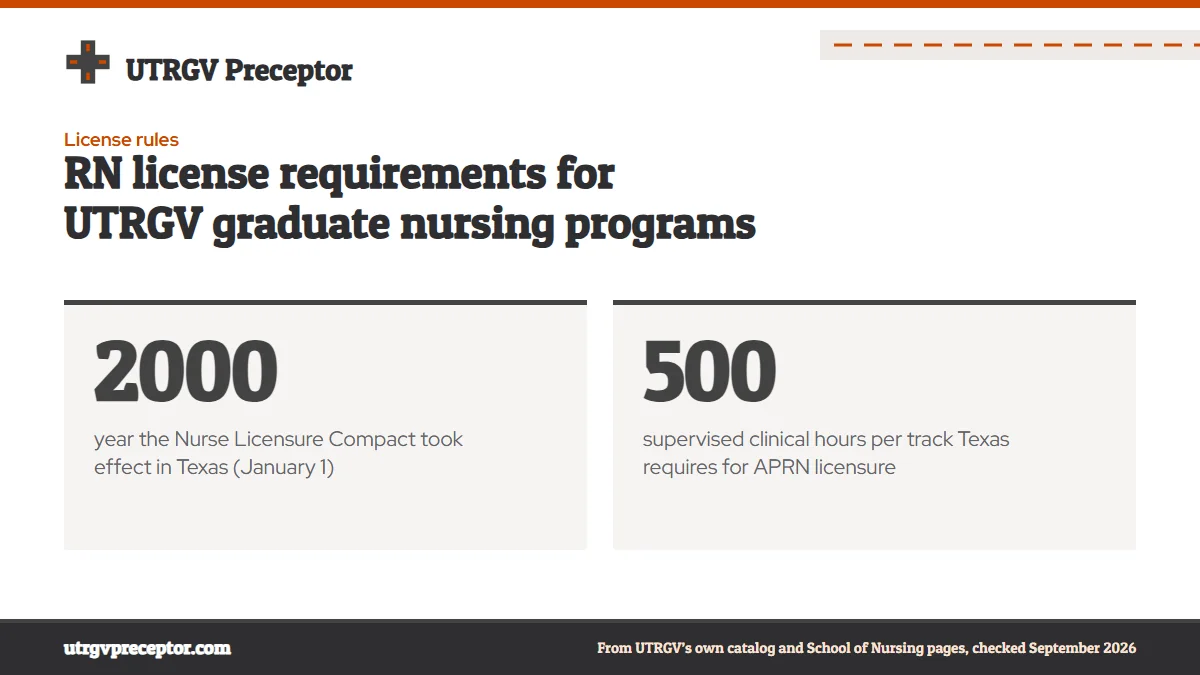
Texas lawmakers adopted the Nurse Licensure Compact in 1999, and the Texas Board of Nursing dates its start to January 1, 2000. Under it, a nurse living in a fellow member state may work in Texas on the multistate RN license issued back home. The BON's APRN practice FAQ adds the other side: someone living in a non-member state must hold a Texas RN license to practice in Texas.
The compact covers RN and LVN licenses only. Texas has not implemented the separate APRN Compact, and nationally just five states have enacted it (Utah, Wyoming, Delaware and the two Dakotas), two short of the seven needed to switch it on. So an APRN license stays a single-state license. For a PMHNP student in another state, the practical result is simple: the license that matters is the one from your home state, and your APRN license after graduation will come from that state's board too.
After certification: APRN licensure in brief
Graduating is not the same as being licensed as an APRN. In Texas, the Board of Nursing's rules require an APRN program to include a formal preceptorship plus no fewer than 500 supervised hours in each track, directly linked to the population focus and role you seek. UTRGV's three FNP specialty courses carry 605 hours and the PMHNP certificate 520, both above that floor.
The usual order is national certification in your population focus, then an application to your state's board. UTRGV names no certifying body for either track; the NP certification exams page covers the choices. In Texas, prescriptive authority requires full APRN licensure, RNs with interim approval to practice as APRNs are not eligible for it, and nurse practitioners prescribe under authority a physician delegates through a written agreement; our Texas NP practice guide has the detail. PMHNP graduates outside Texas apply to their own board; UTRGV's old PMHNP answers page sent nurses to that board to ask about licensure with the certificate.
How your license shapes the preceptor search
Your license decides where you can train, so it is the first thing we check. For FNP students, we start in the Rio Grande Valley and widen the search across Texas until the fit with the course and UTRGV's rules is right. For PMHNP students, we search your home state, where your license is, and we confirm the preceptor's certification before any introduction. For DNP students, we match the project site to the state your license covers. If your license comes up for renewal during a rotation, it goes on your dated compliance list beside your TB test and flu shot.
Getting that right early keeps an affiliation agreement from being built around a site you cannot use. Share your program, license state and next course through the request form, or start with how our process runs.
Questions UTRGV students ask
Can I enter UTRGV's MSN-FNP holding a compact license issued outside Texas?
The catalog asks for a Texas RN license, while the archived 2023-24 graduate guide spoke of a Texas or state-of-residence license. The compact itself already lets a member state's multistate license cover practice in Texas, but UTRGV's written rule still names Texas. Put the question to the MSN-FNP program coordinator before applying, and keep the reply on file.
Do I need a Texas license for UTRGV's online PMHNP certificate if I live in another state?
Neither the 2026-27 catalog nor the June 2025 flyer asks for one. Both look to your home-state license, and your clinical hours happen there too. The 2016 flyer is the last UTRGV document we found asking PMHNP applicants for a Texas RN license. Confirm with the PMHNP program, since the catalog and the flyer still disagree on APRN versus RN.
Will a Texas APRN license let me practice as an NP in other states?
Not on its own. Texas has not implemented the APRN Compact, and the compact is not yet operating anywhere, so each state licenses its own APRNs. A multistate RN license reaches RN practice across member states and nothing beyond it. Plan on a separate APRN application in any other state where you want to practice as a nurse practitioner.
My RN license expired in the middle of a UTRGV clinical course. What now?
UTRGV's catalog treats a current license as a standing requirement, not a one-time admission check, and in clinicals you practice on that license. Stop clinical hours at once and let your course coordinator or clinical faculty know right away, since hours worked on a lapsed license put the course at risk. Setting a renewal reminder well ahead of your expiration date avoids the problem.
Related pages
Last checked 2026-09-27
We check these pages against UTRGV's own catalog, course syllabi, School of Nursing pages and Texas Board of Nursing rules. Your course faculty and the School of Nursing have the final word.
From the approved list or a brand-new site, we find the preceptor who fits.
Tell us your UTRGV program, where you live and when your next clinical course starts. We line up a willing preceptor who fits the course and UTRGV's rules, and hand you the details the Clinical Request Form, the affiliation agreement and the preceptor agreement ask for, well before the semester.
- Family practice preceptors for
NURS 6612andNURS 6613, and two NP sites forNURS 6347 - Board-certified psychiatric preceptors for
NURS 6476andNURS 6620, in your home state - Across the Valley and Texas, from McAllen and Brownsville to San Antonio, Houston and beyond
- A replacement lined up fast if a preceptor drops
Start your placement plan
Program, city and start date is all we need to begin.