NP certification exams for UTRGV FNP and PMHNP students
UTRGV prepares FNP and PMHNP students for national certification but names no certifying board and publishes no board pass rates. The one board that shows up in UTRGV's documents is ANCC, in its rule on who may precept PMHNP students. Here is what that means for choosing an exam, how the last FNP semester runs up to it, and what Texas asks of you once you certify.
Get your placement plan
Tell us your UTRGV program and where you live. A placement advisor replies with preceptor and site options in your community that fit your UTRGV course.
What UTRGV says about board certification
Very little, directly. Across the catalog, the program pages, the flyer for the PMHNP certificate and the School's own web pages, accreditation included, no certifying body is named for FNP or PMHNP graduates, and UTRGV reports no certification pass rates. Its state authorization page says only that programs leading to licensure are designed to meet Texas licensure and certification requirements and to prepare students for licensure exams in Texas.
Two indirect signals exist. UTRGV's PMHNP preceptor rule accepts a psychiatric mental health nurse practitioner board certified by ANCC, the American Nurses Credentialing Center, alongside psychiatrists certified by the American Board of Psychiatry and Neurology (ABPN). And the removed PMHNP FAQ, read from an archived copy, advised spending about 120 hours with children and adolescents to round out the clinical experience with the boards in mind.
So the exam decision sits with you. Ask your course faculty which exams recent graduates took; they see the cohorts that UTRGV's public pages do not describe.
The FNP boards, in general terms
Family nurse practitioners certify through a national board, and the two names FNP students usually weigh are AANPCB and ANCC. UTRGV's pages mention neither for the FNP. Each board sets its own eligibility rules, application steps and exam content in its own current candidate handbook; read that handbook, not a summary of it, before you apply.
What UTRGV hands you toward any board is the program record: a CCNE-accredited MSN-FNP or post-master's FNP certificate, and clinical hours in NURS 6347, NURS 6612 and NURS 6613, 605 across the three specialty courses, logged in Typhon with preceptor signatures. Keep your own copies of logs and evaluations as each course closes.
The course populations already describe a broad family practice. NURS 6612 covers common episodic and chronic conditions of children and adults, NURS 6310 includes pregnant women among essentially healthy children and adults, and NURS 6311 centers on rural primary care. A preceptor mix that actually puts those patients in front of you is the practical preparation the courses expect; finding a preceptor explains how we match for it.
The PMHNP board
For PMHNPs, ANCC is the board UTRGV's own documents point toward, since an ANCC-certified PMHNP is one of the two kinds of preceptor the program accepts. UTRGV does not tell students which exam to sit. The certificate supplies the coursework and the supervised hours, 520 on a 2017 UTRGV form, that stand behind your application.
The lifespan runs through the courses. NURS 6475 covers infants, children, adolescents and their families, NURS 6476 young and older adults, and NURS 6620 the full lifespan. The archived FAQ's advice about time with young patients is easiest to follow when a preceptor, or a second site, sees children and adolescents, and that is something we check before we propose a match.
Remote hours are capped, and UTRGV's sources disagree on the cap. Read telepsychiatry hours before you plan a placement that leans on them.
How the final FNP semester lines up
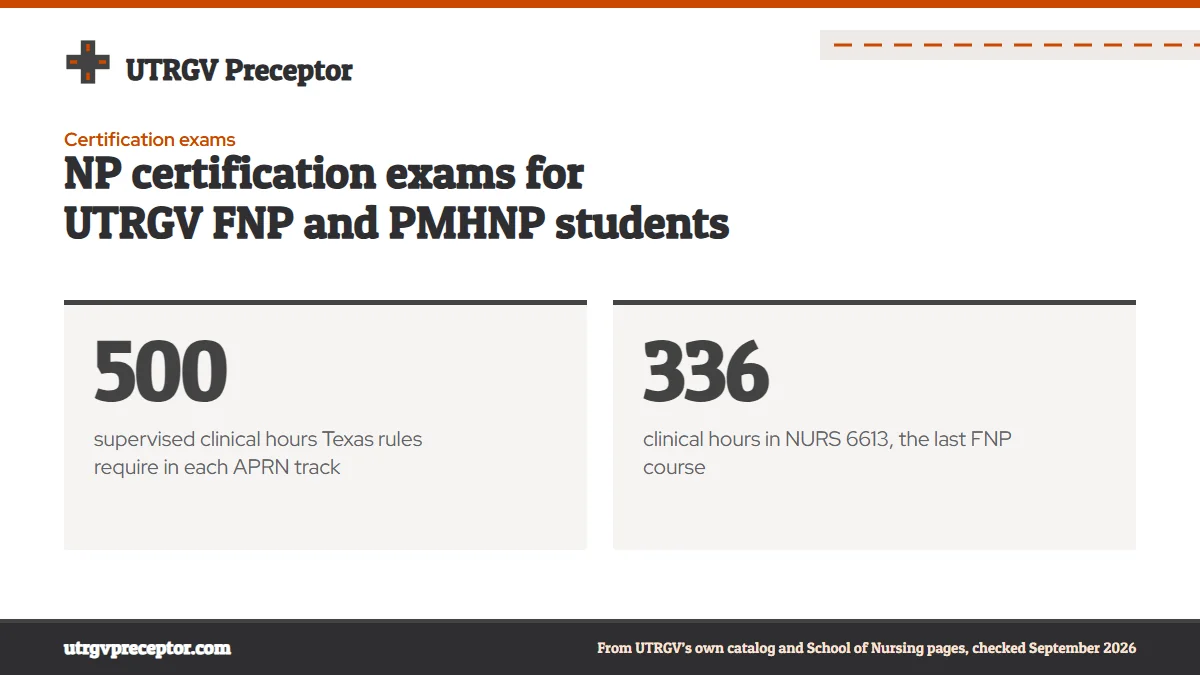
In UTRGV's published FNP sequence, the last clinical course is NURS 6613, Family Nurse Practitioner II, in a spring semester: year two for full-time students and year three for part-time students under the 2019 plan. It carries 336 hours at 24 hours a week over two 7-week rotations, and the catalog describes students taking on more of the management of patients as preceptors and faculty validate their competence.
The spring term sets the pace: in 2027 it opens January 19 and closes May 13, after finals week (May 7 to 13), with commencement on May 14 and 15. The course closes with a stack of required forms: the preceptor's clinical evaluation of you, the faculty evaluation, your evaluations of the preceptor and the site, the signed preceptor agreement forms and the time reports.
Hours cannot be finished early without a legitimate reason and the course coordinator's approval, so the schedule has little give. The biggest threat to a May finish, and so to your board timeline, is a preceptor who leaves mid-semester. A backup lined up before January is the most useful protection you can have, and it is built into every search we run. More in NURS 6613.
Texas APRN licensure after certification
Passing a board exam is not the finish line for practice in Texas. The Texas Board of Nursing licenses APRNs, and certification comes before that license. The Board's APRN licensure rule, 22 TAC §221.3, calls for a formal preceptorship and at least 500 supervised clinical hours in each track, tied to the role and population focus of the license and including pharmacotherapeutic management. UTRGV's FNP hours (605 in the specialty courses) and PMHNP hours (520) both sit above that floor.
Prescribing is its own step. Under 22 TAC §222.2, prescriptive authority requires full APRN licensure, and an RN with interim approval to practice as an APRN is not eligible. Prescribing then runs through a prescriptive authority agreement with a physician, and the Board's APRN FAQ reminds nurses that Texas APRNs do not have full practice authority. Texas NP practice covers the agreement itself.
PMHNP students licensed outside Texas
Many PMHNP certificate students live and train outside Texas, and for them the APRN license comes from their home state's board. UTRGV publishes no state-by-state findings on whether its certificate meets each board's rules. The advice runs the other way: the flyer tells applicants to confirm, before applying, that their home board has approved UTRGV, and the removed FAQ told graduates to ask their own board whether they can be licensed with the UTRGV certificate.
Make that check early, not after boards. The same board may have rules for out-of-state programs placing students in its clinics, which touches your clinical site as well as your license. PMHNP clinicals outside Texas and RN license rules cover both sides.
Our part is the clinical record your certification and license will stand on: a preceptor in your state who meets UTRGV's rule, an ABPN psychiatrist or an ANCC-certified PMHNP, with hours that count.
Questions UTRGV students ask
Which certification exam does UTRGV recommend for FNP students?
UTRGV does not recommend one on any public page, and its catalog, program pages and accreditation page are silent on the choice. Compare the current candidate handbooks of the boards you are considering, ask your course faculty what recent graduates chose, and plan the application around your final spring semester.
Do I need to pass boards to finish UTRGV's FNP program?
No UTRGV source makes a board exam part of finishing the MSN-FNP or the post-master's certificate. Completion rests on the courses: each clinical course requires its full hours and a satisfactory preceptorship grade, and the MSN has a five-year limit. See grades and progression.
Can I prescribe in Texas as soon as I pass my FNP boards?
Not straight away. Texas ties prescriptive authority to full APRN licensure from the Board of Nursing, so the license comes first, and interim approval to practice as an APRN does not carry prescribing. After licensure, prescribing is delegated through a written prescriptive authority agreement with a physician.
Are UTRGV's clinical hours enough for board and license applications?
UTRGV's totals clear the Texas floor of 500 supervised hours per track: 605 across the three FNP specialty courses and 520 for the PMHNP certificate. The older 2023-24 guide listed 800 total hours for the MSN-FNP. Keep signed logs and evaluations from every course so you can document your hours whenever you are asked.
Why must UTRGV PMHNP preceptors be ANCC or ABPN certified?
It is UTRGV's rule, stated in the archived graduate FAQ with no exceptions: an ABPN-certified psychiatrist more than a year past residency, or an ANCC board-certified PMHNP. In practice it means your supervision comes from someone certified in the specialty you are training for. Preceptor requirements has the full rule.
Related pages
Last checked 2026-09-27
We check these pages against UTRGV's own catalog, course syllabi, School of Nursing pages and Texas Board of Nursing rules. Your course faculty and the School of Nursing have the final word.
From the approved list or a brand-new site, we find the preceptor who fits.
Tell us your UTRGV program, where you live and when your next clinical course starts. We line up a willing preceptor who fits the course and UTRGV's rules, and hand you the details the Clinical Request Form, the affiliation agreement and the preceptor agreement ask for, well before the semester.
- Family practice preceptors for
NURS 6612andNURS 6613, and two NP sites forNURS 6347 - Board-certified psychiatric preceptors for
NURS 6476andNURS 6620, in your home state - Across the Valley and Texas, from McAllen and Brownsville to San Antonio, Houston and beyond
- A replacement lined up fast if a preceptor drops
Start your placement plan
Program, city and start date is all we need to begin.