Your own UTRGV preceptor search, or ours: a fair comparison
Both routes end at the same gate: a preceptor and site that UTRGV's faculty approve before any hour counts. A solo search costs you time, calls and follow-up; a placement search costs a service fee and hands the calling, course matching and new-site groundwork to us. Here is how the two compare at each stage of a UTRGV search, and when each one is the better choice.
Get your placement plan
Tell us your UTRGV program and where you live. A placement advisor replies with preceptor and site options in your community that fit your UTRGV course.
What a solo search looks like at UTRGV
In the FNP courses, the Spring 2026 NURS 6305 syllabus makes the search yours, and UTRGV gives you a real head start: its list of approved preceptors and affiliated practices inside Brightspace. From there, a search on your own tends to move through three rounds.
- Calling down the list. You phone or visit each listed practice within reach, ask whether a clinician has room in your term and explain the weekly load. A listing means UTRGV already has paperwork with the facility, not that anyone there has an opening.
- Cold calls off the list. When listed practices say no, you approach clinics UTRGV has never worked with, CV and course objectives in hand, and repeat the pitch for each one.
- A new agreement. A willing clinician at an unlisted clinic means a Clinical Request Form, a Typhon data sheet and an affiliation agreement, budgeted at 30 to 90 days in UTRGV's PMHNP guidelines.
PMHNP certificate students run the same rounds in their home state. The removed graduate FAQ (archived May 2025) suggested phoning a prospective preceptor and bringing a CV to the interview, while the live June 2025 flyer mentions placement assistance it never defines; PMHNP placement assistance compares the two.
Side by side, stage by stage
The table follows a UTRGV search from the first call to the last clinical week.
| Stage | Searching on your own | With our placement desk |
|---|---|---|
| Approved list | You contact each listed practice near you, one at a time, between shifts and classes | We approach the listed practices near you with your exact dates and weekly hours |
| Off-list clinics | Cold calls and visits, with your CV and objectives ready each time | We reach clinicians across the Valley, the rest of Texas or your home state |
| Course fit | You check every candidate against the course rules yourself | Each candidate is screened first: NP, PA or MD/DO for FNP courses, two NPs at two sites for NURS 6347, ABPN or ANCC for PMHNP |
| Weekly load | You confirm the clinic can host 16 or 24 hours a week | We match the preceptor's clinic days to the full load before anything is signed |
| New-site paperwork | You collect facility and preceptor details for the Clinical Request Form | We collect those details and the Typhon data sheet credentials for you to submit |
| If a preceptor drops | You restart the search mid-term, alone | We start the replacement search as soon as you tell us |
| What it costs | Your time, fuel and phone hours | A service fee; see what shapes the cost |
| Who approves | UTRGV faculty | UTRGV faculty |
When searching alone makes good sense
A solo search is a sound choice when most of the pieces are already in place:
- A listed practice near home has a clinician who knows you and has room in your term.
- Your next course is one of the 45-hour pieces,
NURS 6305,NURS 6310orNURS 6311, and the clinic sees the patients that course describes. - You have a full term or more before hours start, so a new agreement has its whole 30 to 90 days.
- Your schedule leaves daytime hours for calls, visits and interviews.
If you go it alone, keep a written log of every practice you contact, with the date and the answer. It stops repeat calls to the same office and gives your course coordinator a clear picture if you ask for help later. The approved list guide shows how to work the list well.
When a placement search earns its place
The case for help grows with the size of the course and the shortness of the runway. A search from us is worth it when you face any of these:
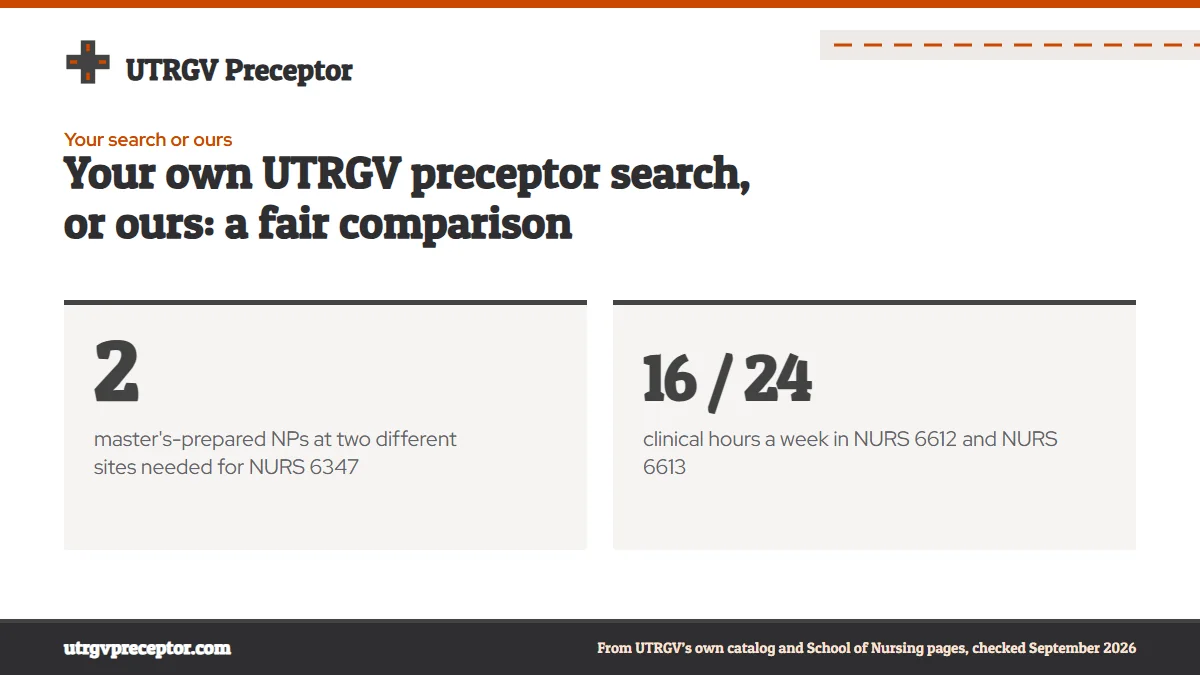
NURS 6612orNURS 6613, where one preceptor must hold 16 or 24 hours a week through two 7-week rotations, for 224 and then 336 hours.NURS 6347, which needs two master's-prepared NPs at two separate approved sites, each precepting only you.- A PMHNP certificate in a state where you know few psychiatric clinicians, with only ABPN-certified psychiatrists or ANCC-certified PMHNPs eligible and your workplace ruled out.
- Less than a term before hours start, or a listed practice that has already said no.
- A preceptor who left partway through a course.
In each case the hard part is a clinician with room at the right pace, which is the whole of our work. How it works shows the steps we follow.
Running both searches at once
You do not have to pick one route. A split search suits UTRGV well because the approved list sits inside your Brightspace course, not on the public web: you keep calling the listed practices you already know, we take the off-list search and the new-site groundwork, and one shared record of every contact means no office hears about you twice.
Whichever yes arrives first and fits the course goes to UTRGV for approval. If you land a preceptor yourself after we begin, tell us, and we turn to backup planning so a late change at the clinic does not leave you without hours. Working this way also keeps the list-first order intact, since listed practices need no new agreement.
What stays the same on either route
Neither route changes UTRGV's standards. NURS 6347 counts only university-approved sites, FNP preceptors must be qualified and approved NPs, PAs or physicians, the signed preceptor agreement and Mandatory Weekly Time Report reach faculty at least a week before FNP clinicals, PMHNP students wait for their clinical faculty's clearance, and every log needs your preceptor's signature each week.
A preceptor we find goes through exactly the review a preceptor you find does, and hours start only after that approval, however the match was made. Typhon logging, compliance documents and the end-of-course evaluations stay with you on both routes. The placement process sets out each UTRGV step, and the form below starts a search whenever you are ready.
Questions UTRGV students ask
Will UTRGV treat a preceptor I found differently from one a service found?
UTRGV's published steps draw no such line. Every preceptor and site passes the same checks: a listed or newly affiliated site, a preceptor who meets the course rules, a signed preceptor agreement and faculty approval before hours begin. Faculty look at fit and completeness, and those are exactly what we prepare.
How long does a solo UTRGV preceptor search take?
UTRGV publishes no average. The fixed piece is paperwork: a clinic new to UTRGV needs an affiliation agreement that the PMHNP guidelines put at 30 to 90 days once complete. Add the weeks of calls before someone says yes, and starting a full term ahead is sensible for NURS 6612 or NURS 6613.
Can I keep calling the approved list while you search?
Yes, and we encourage it. Tell us which listed practices you have contacted and what each one said, and we concentrate on the rest. A single shared record means no office hears from two people about the same student, which keeps practices open to UTRGV students in later terms.
Is placement help worth it for a 45-hour course?
Often not, if a listed practice near you has room. The 45-hour clinical pieces of NURS 6305, NURS 6310 and NURS 6311 are short, though NURS 6347 is harder because it needs two NPs at two sites. The long courses, NURS 6612 and NURS 6613, are where a professional search saves the most time.
What if I find my own preceptor after you start?
Tell us straight away. We check that the preceptor fits the course, help gather the Clinical Request Form details if the clinic is new to UTRGV, and shift our effort to a backup at a listed practice, so a late cancellation at the clinic does not cost you weeks of hours.
Related pages
Last checked 2026-09-27
We check these pages against UTRGV's own catalog, course syllabi, School of Nursing pages and Texas Board of Nursing rules. Your course faculty and the School of Nursing have the final word.
- UTRGV Graduate Catalog 2026-27: NURS 6305 Advanced Health Assessment (Spring 2026 syllabus cited in text)
- UTRGV Graduate Catalog 2026-27: NURS 6347 Role Development for the Nurse Practitioner (Summer 2025 syllabus cited in text)
- UTRGV PMHNP certificate flyer (June 2025)
- UTRGV Graduate Program FAQs (archived May 2025)
- UTRGV PMHNP Guidelines for the Clinical Request Form (archived)
From the approved list or a brand-new site, we find the preceptor who fits.
Tell us your UTRGV program, where you live and when your next clinical course starts. We line up a willing preceptor who fits the course and UTRGV's rules, and hand you the details the Clinical Request Form, the affiliation agreement and the preceptor agreement ask for, well before the semester.
- Family practice preceptors for
NURS 6612andNURS 6613, and two NP sites forNURS 6347 - Board-certified psychiatric preceptors for
NURS 6476andNURS 6620, in your home state - Across the Valley and Texas, from McAllen and Brownsville to San Antonio, Houston and beyond
- A replacement lined up fast if a preceptor drops
Start your placement plan
Program, city and start date is all we need to begin.