What precepting a UTRGV nurse practitioner student involves
A UTRGV nurse practitioner student joins your practice for one clinical course at a time, on a weekly schedule the course sets, with a short set of UTRGV papers: an agreement, the course objectives, an orientation packet, a weekly log to sign and a final evaluation. Here is what each course asks of you, who qualifies, and how our placement desk keeps your share small.
Open to precepting?
Choose "I'm a preceptor" under Program and add your city. A placement advisor gets back to you about which UTRGV course suits your practice.
Who the student is
Every UTRGV nurse practitioner student is already a registered nurse. The MSN-FNP and the post-master's FNP certificate require a Texas RN license and are campus-based, with classes in Edinburg, so in practice FNP students train in Texas and come back to campus for weekly classes. The PMHNP certificate is 100% online, so its students live in many states and train close to home. Post-master's students, FNP or PMHNP, already hold a master's in nursing.
Before the first clinic day, UTRGV has cleared its own side: a seven-year background check, the School of Nursing immunization form with yearly TB and flu, liability insurance, HIPAA training and a signed confidentiality statement. FNP students arrive in a white lab coat with a UTRGV MSN student name tag.
FNP courses: hours and the weekly rhythm
Four FNP courses are short 45-hour blocks; two long ones hold most of the clinical time at a fixed weekly load, per the Fall 2025 NURS 6612 and Spring 2026 NURS 6613 syllabi.
| Course | Hours | Weekly load | Preceptor |
|---|---|---|---|
NURS 6305, NURS 6310, NURS 6311 | 45 each | Not published | NP, PA or MD/DO approved by UTRGV |
NURS 6347 Role Development | 45 | Up to 8 hours a day | Master's-prepared NPs only, one student each |
NURS 6612 FNP I | 224 | 16 hours, two 7-week rotations | NP, PA or MD/DO approved by UTRGV |
NURS 6613 FNP II | 336 | 24 hours, two 7-week rotations | NP, PA or MD/DO approved by UTRGV |
Our arithmetic, not a UTRGV figure: one 7-week block is 112 hours in NURS 6612 and 168 in NURS 6613, so ask whether the student wants one block or both. NURS 6612 covers episodic and chronic problems in children and adults; in NURS 6613 the student takes on more of each visit as you and faculty confirm competence. Neither course lets a student finish early without the course coordinator's prior approval.
NURS 6347: nurse practitioners only, one student each
The role course has the tightest FNP rule. Its Summer 2025 syllabus spreads 45 hours across at least two nurse practitioners with master's preparation, at two different sites, and each takes a single UTRGV student. Physician assistants and physicians, welcome in the other FNP courses, sit this one out.
For an NP the ask is small: part of 45 hours, in shifts of eight hours or fewer, during a summer term, at a university-approved practice the course coordinator signs off on. In Summer 2025 the course also counted a Texas DSHS Operation Border Health event in Los Fresnos toward its clinical work, so part of the student's calendar may be spoken for. Dates are in the NURS 6347 guide.
PMHNP courses: board certification comes first
The online PMHNP certificate has two precepted courses: 220 hours in NURS 6476 in the fall and 300 in NURS 6620 in the spring, per the 2025-26 syllabi, for 520 in all, across the lifespan. UTRGV's archived graduate FAQ suggested about 120 of those hours with children and adolescents.
Two kinds of clinician qualify: a psychiatrist with American Board of Psychiatry and Neurology certification who finished residency more than a year ago, or a psychiatric mental health NP with ANCC board certification. The FAQ allowed no substitutes and ruled out the student's own workplace, and the student's assigned clinical faculty member clears your site before any hour counts. Telepsychiatry hours are capped, at 75 of 520 in the archived FAQ or 220 in the Spring 2026 NURS 6620 syllabus; the telepsychiatry guide compares them.
Before the first day: agreement, objectives, orientation packet
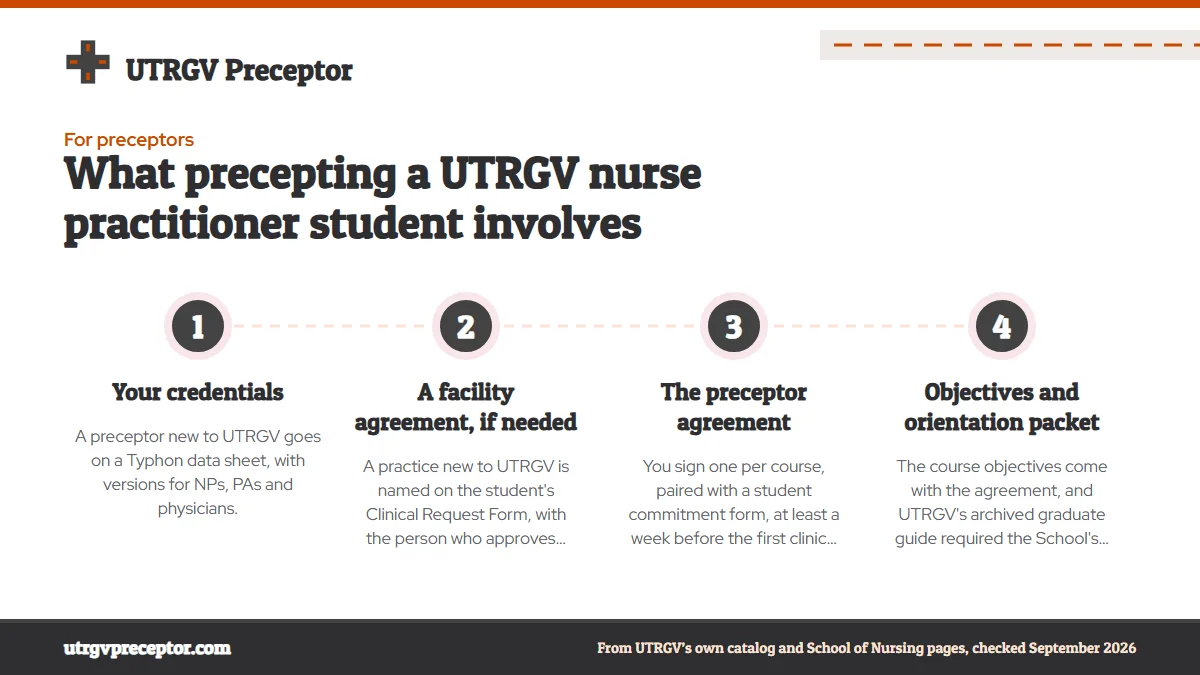
Most of UTRGV's paper travels through the student, in this order.
- Your credentialsA preceptor new to UTRGV goes on a Typhon data sheet, with versions for NPs, PAs and physicians.
- A facility agreement, if neededA practice new to UTRGV is named on the student's Clinical Request Form, with the person who approves agreements; UTRGV's PMHNP guidelines allow 30 to 90 days.
- The preceptor agreementYou sign one per course, paired with a student commitment form, at least a week before the first clinic day in FNP courses.
- Objectives and orientation packetThe course objectives come with the agreement, and UTRGV's archived graduate guide required the School's preceptor orientation packet to reach you before any clinical work starts.
During the rotation: signatures, site visits, evaluations
Your weekly task on paper is a signature: the NURS 6612 grading criteria reject a clinical log without your weekly signature or your evaluation. Hours also go into Typhon, which faculty and preceptors can both view, and FNP students hand in a Mandatory Weekly Time Report each Wednesday class covering this week and next, because FNP faculty make random site visits. PMHNP oversight runs remotely through the clinical faculty member.
At the end you evaluate the student and the student rates you and the site. Your evaluation counts: a long FNP course is passed only with every hour done and a satisfactory preceptorship grade. PMHNP students also ask you to sign a letter verifying their clock hours.
Sign the log each week rather than in one batch at the end. Unsigned weeks can stall the student's course.
Texas rules in brief
Under 22 TAC §219.2(19), a qualified preceptor for advanced practice students is an APRN, physician or other professional the Board of Nursing accepts, with an active, unencumbered license and current practice in the specialty, who supervises, teaches and evaluates. Section 219.10 adds written agreements among school, preceptor and facility, objectives shared beforehand, and faculty who keep in regular contact with you, by phone, in writing or through simulation when a visit is not feasible. UTRGV's syllabi follow that pattern.
Your hours also feed the 500 supervised hours §221.3 requires for licensure, and because Texas NPs lack full practice authority, an NP preceptor can show the student how a prescriptive authority agreement with a physician works day to day. The Texas BON preceptor rules and Texas NP practice guides go further.
How we keep your part light
Our placement desk handles the coordination so your time goes to teaching. The first call covers the course, hours, weekly load and dates.
- A student whose course fits your patients, and PMHNP students only when your certification meets UTRGV's rule.
- Your license and practice details gathered in one call, ready for the data sheet and request form.
- The agreement and objectives ready to sign well before the one-week line.
- A schedule settled up front and a reminder before the final week for your evaluation and any hours letter.
- Any schedule change goes to your placement advisor, who reworks the plan with the student.
Open to hosting a UTRGV student? Use the form and choose the preceptor option, or see how it works from the student's side.
Questions UTRGV students ask
Do I have to be on UTRGV's approved preceptor list already?
No. Students look at the list in Brightspace first, but a clinician new to UTRGV can be added through a Typhon data sheet, and a practice without an affiliation goes through the Clinical Request Form so UTRGV can reach an agreement with your facility. The approved list guide explains the list.
How many UTRGV students can I precept at the same time?
UTRGV states a limit only for NURS 6347: one student per preceptor. The other syllabi set no number, so the real limit is whether each student gets 16 or 24 hours of genuine patient care a week. The Texas cap of six students per faculty member applies to UTRGV's faculty, not to preceptors.
Can I precept a UTRGV PMHNP student if I practice outside Texas?
Yes. PMHNP students complete their hours in their own state of residence, and UTRGV's state authorization list covers every state except California. Your state may have rules for nursing programs based elsewhere, and UTRGV needs an agreement with your facility. The out-of-state clinicals guide covers them.
Does precepting a UTRGV DNP student work the same way?
Broadly, with a different focus. A DNP student runs a practice project at an approved site: NURS 8211 grades 100 hours of clinical logs, and NURS 8512 asks for a data sheet for a physician or DNP-prepared APRN, a preceptor agreement and evaluations both ways.
Related pages
Last checked 2026-09-27
We check these pages against UTRGV's own catalog, course syllabi, School of Nursing pages and Texas Board of Nursing rules. Your course faculty and the School of Nursing have the final word.
- UTRGV Graduate Catalog 2026-27: NURS 6612 Family Nurse Practitioner I
- UTRGV Graduate Catalog 2026-27: NURS 6347 Role Development for the Nurse Practitioner
- UTRGV School of Nursing Graduate Program FAQs (archived May 2025)
- UTRGV Graduate Nursing Student Guide 2023-2024 (archived)
- Texas Board of Nursing Rules and Regulations, 22 TAC chapters 219, 221 and 222 (December 2024)
From the approved list or a brand-new site, we find the preceptor who fits.
Tell us your UTRGV program, where you live and when your next clinical course starts. We line up a willing preceptor who fits the course and UTRGV's rules, and hand you the details the Clinical Request Form, the affiliation agreement and the preceptor agreement ask for, well before the semester.
- Family practice preceptors for
NURS 6612andNURS 6613, and two NP sites forNURS 6347 - Board-certified psychiatric preceptors for
NURS 6476andNURS 6620, in your home state - Across the Valley and Texas, from McAllen and Brownsville to San Antonio, Houston and beyond
- A replacement lined up fast if a preceptor drops
Start your placement plan
Program, city and start date is all we need to begin.