UTRGV site visits and clinical evaluations
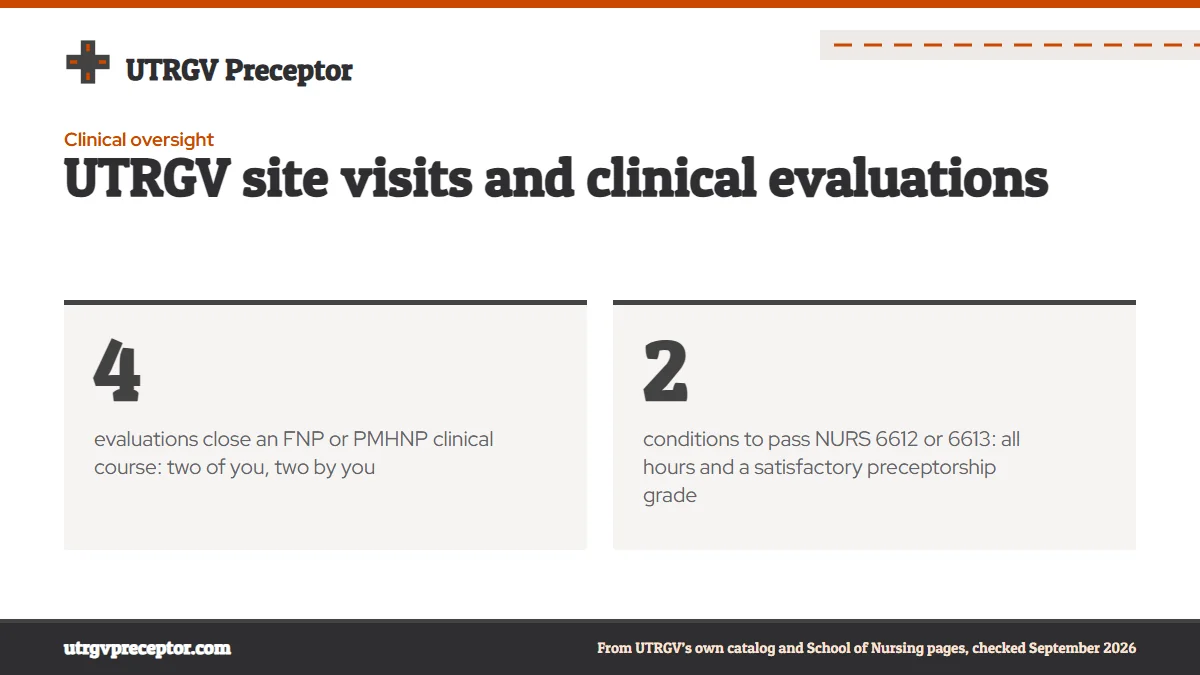
UTRGV faculty keep watch on your clinical time in two ways. FNP faculty visit sites at random, while PMHNP students, spread across many states, are overseen from a distance by an assigned clinical faculty member. Every course ends with evaluations running both ways, and an FNP clinical is passed only with every required hour logged and a satisfactory preceptorship grade.
Get your placement plan
Tell us your UTRGV program and where you live. A placement advisor replies with preceptor and site options in your community that fit your UTRGV course.
Who oversees your clinical time
Responsibility is shared, and the archived 2023-24 graduate guide spells out how. Your preceptor judges your progress in a written evaluation when the experience ends. The faculty and the course coordinator hold final responsibility for monitoring and evaluating you in every clinical course. That division tells you whom to call: your preceptor for the day-to-day, and your clinical faculty or course coordinator for anything that touches your hours or grade. The who does what guide names each role.
How faculty carry that out depends on the program. FNP students train at Texas sites, and FNP faculty may turn up at any of them. The PMHNP certificate is fully online with students in their home states, so oversight runs through an assigned clinical faculty member, Typhon logs and virtual meetings. DNP students sit down with their project faculty advisors four or more times during NURS 8211, per its Fall 2025 syllabus.
FNP courses: random site visits
Four FNP syllabi warn that faculty may appear. The Fall 2025 NURS 6612 and Spring 2026 NURS 6613 syllabi say faculty make random site visits, the Spring 2026 NURS 6305 syllabus says the same about its primary care hours, and the 2023 NURS 6311 syllabus says faculty can visit at random.
Those visits are the reason the Mandatory Weekly Time Report covers this week and next: it is how faculty know where to find you. Being somewhere other than the site on your report turns a routine visit into something you have to explain. When a clinic day changes, update the report and let every one of your clinical faculty know, which the NURS 6612 and NURS 6613 syllabi expect for any absence. The report itself is covered in the agreement and forms guide.
A visit is also a look at the preceptorship itself. It goes smoothly when your preceptor knows faculty may drop in and has the course objectives on hand.
PMHNP: oversight from a distance
Each PMHNP student is assigned a member of the clinical faculty, the title UTRGV gives its adjunct clinical instructors, according to the archived FAQ. That person clears your preceptorship before hours start and follows your work through the term. You are assigned to a clinical group before your first practicum course opens and stay with it until you finish.
The tools are remote. Hours go into Typhon, where the FAQ says both faculty and preceptors can check logs for accuracy, and the Spring 2026 NURS 6620 syllabus sets virtual lab-group sessions with the clinical faculty to work through unfolding case studies. No UTRGV source reviewed for this guide describes PMHNP site visits in person.
Texas rules allow for exactly this. 22 TAC §219.10(e)(4) says: "If site visits are not feasible, communication and evaluation are managed by alternatives such as telephone, written communications, or clinical simulations." The same provision holds the designated faculty member responsible for your learning and expects regular contact with you and your preceptor. More in the Texas BON preceptor rules.
The evaluation forms, both ways
The form titles differ by program, but the pattern holds: judgments of you from your preceptor and your faculty, and judgments of the preceptor and the site from you. The FNP list calls these required clinical forms, so treat your own evaluations as seriously as the ones about you.
| Evaluation | FNP (NURS 6613, Spring 2026) | PMHNP (NURS 6476, Fall 2025) | DNP (NURS 8512, Spring 2026) |
|---|---|---|---|
| You, by your preceptor | Family Nurse Practitioner Student Clinical Evaluation by Preceptor | Student Evaluation by Preceptor | DNP Preceptor Evaluation of DNP Student |
| You, by faculty | FNP-Student Clinical Evaluation by Faculty | Student Evaluation by Faculty | Not on the forms list; advisors meet you in NURS 8211 |
| Your preceptor, by you | Evaluation of Preceptor by Student | Preceptor Evaluation by Student | Evaluation of DNP Preceptor by DNP Student |
| Your site, by you | Evaluation Survey of Clinical Site by Student | Clinical Site Evaluation by Student | Evaluation Survey of Clinical Site by Student |
In NURS 6620, the Spring 2026 grading table lists a clinical evaluation by faculty and another by the preceptor. The layout shows a 15% weight beside those lines, but not how it divides between them, so ask your clinical faculty how the two combine.
What it takes to pass a clinical course
In the FNP clinical courses, passing rests on two conditions that stand apart from your theory grade. The NURS 6612 syllabus makes you finish every one of its 224 hours and earn a satisfactory grade for the preceptorship, no matter how the theory grade turns out; NURS 6613 holds its 336 hours to the same standard.
Hours count only when the records back them. The NURS 6612 log criteria turn away any log missing the preceptor's weekly signature or evaluation. The PMHNP courses set hour thresholds for passing as well: 220 hours with a preceptor in NURS 6476 and 300 precepted hours in NURS 6620, per their 2025-26 syllabi.
Progression adds one more bar. The archived 2023-24 guide said anything under a B in a clinical course halts your progression in the program; the grades and progression guide explains what follows.
A strong exam average does not carry an FNP clinical course. Missing hours or an unsatisfactory preceptorship grade is enough on its own to keep you from passing, so guard your hours and your preceptor relationship as closely as your test scores.
How we set you up for strong evaluations
Your evaluation starts the day you choose a preceptor. We look for clinicians who teach: who explain their reasoning, hand you more of the patient load as you prove ready, and finish evaluations on time. That growing responsibility is what the NURS 6613 catalog description asks for, with competence confirmed by preceptors and faculty together.
- We brief each preceptor on UTRGV's evaluation forms and weekly log signatures before your first day.
- We agree on a steady schedule with the preceptor, so the weekly time report holds up if faculty visit.
- We check in partway through the rotation, while there is still time to fix a mismatch.
- If a preceptor steps away, we move quickly on a replacement who fits the same course rule.
Tell us your course and term, or read how it works.
Questions UTRGV students ask
Does UTRGV give FNP students notice before a site visit?
The syllabi call the visits random and publish no notice rule. Plan as though a visit could come on any scheduled day: keep the weekly time report accurate, be at the site it names, and make sure your preceptor knows faculty may stop by. If your plans change, fix the report before the day, not after.
What happens if I miss a scheduled clinical day?
The NURS 6612 and NURS 6613 syllabi ask you to notify all of your clinical faculty of an absence, and your weekly time report should show the change. The missed hours still have to be made up, since every hour in the course is required to pass and hours cannot count toward two courses at once. The rules for counting hours cover the details.
Who decides my clinical grade at UTRGV, the preceptor or the faculty?
Both give input, and faculty decide. Your preceptor completes a written evaluation of you and faculty complete their own, and the archived 2023-24 guide leaves the faculty and course coordinator ultimately responsible for judging your clinical performance. Treat the preceptor's view as central all the same, because the FNP courses require a satisfactory preceptorship grade to pass.
Do UTRGV PMHNP clinical faculty visit sites in person?
No public UTRGV source sets a PMHNP site-visit rule. With students in many states, oversight runs through your assigned clinical faculty member, Typhon logs they can review, and virtual lab-group meetings. Texas rules allow that approach when visits are not feasible and call for regular communication between faculty and preceptor, so keep your preceptor's contact details current with your clinical faculty.
When are UTRGV clinical evaluations due?
At the end of each clinical course. The FNP syllabi list them with the required clinical forms, the NURS 6476 syllabus lists them among the end-of-course uploads, and NURS 8512 has DNP students submit them late in the term. Give your preceptor the form a week or two before the last shift so it is ready in time.
Related pages
Last checked 2026-09-27
We check these pages against UTRGV's own catalog, course syllabi, School of Nursing pages and Texas Board of Nursing rules. Your course faculty and the School of Nursing have the final word.
- UTRGV graduate catalog 2026-27: NURS 6612 Family Nurse Practitioner I (Fall 2025 syllabus cited in text)
- UTRGV graduate catalog 2026-27: NURS 6620 PMHNP 3 Preceptorship (Spring 2026 syllabus cited in text)
- UTRGV School of Nursing: Graduate Program FAQs (archived May 2025)
- UTRGV Graduate Nursing Student Guide 2023-2024 (archived)
- Texas Board of Nursing: rules and regulations, 22 TAC §219.10 (December 2024)
From the approved list or a brand-new site, we find the preceptor who fits.
Tell us your UTRGV program, where you live and when your next clinical course starts. We line up a willing preceptor who fits the course and UTRGV's rules, and hand you the details the Clinical Request Form, the affiliation agreement and the preceptor agreement ask for, well before the semester.
- Family practice preceptors for
NURS 6612andNURS 6613, and two NP sites forNURS 6347 - Board-certified psychiatric preceptors for
NURS 6476andNURS 6620, in your home state - Across the Valley and Texas, from McAllen and Brownsville to San Antonio, Houston and beyond
- A replacement lined up fast if a preceptor drops
Start your placement plan
Program, city and start date is all we need to begin.