UTRGV's rules for counting clinical hours
At UTRGV an hour counts when it belongs to one course, is worked at the pace that course sets, sits on a log your preceptor has signed, and was not earned in another program. The rules below come from the FNP and PMHNP syllabi, UTRGV's archived graduate guide and FAQ, and Texas Board of Nursing rules, with the source named for each one.
Get your placement plan
Tell us your UTRGV program and where you live. A placement advisor replies with preceptor and site options in your community that fit your UTRGV course.
NURS 6612, over two 7-week rotationsNURS 6613, over two 7-week rotations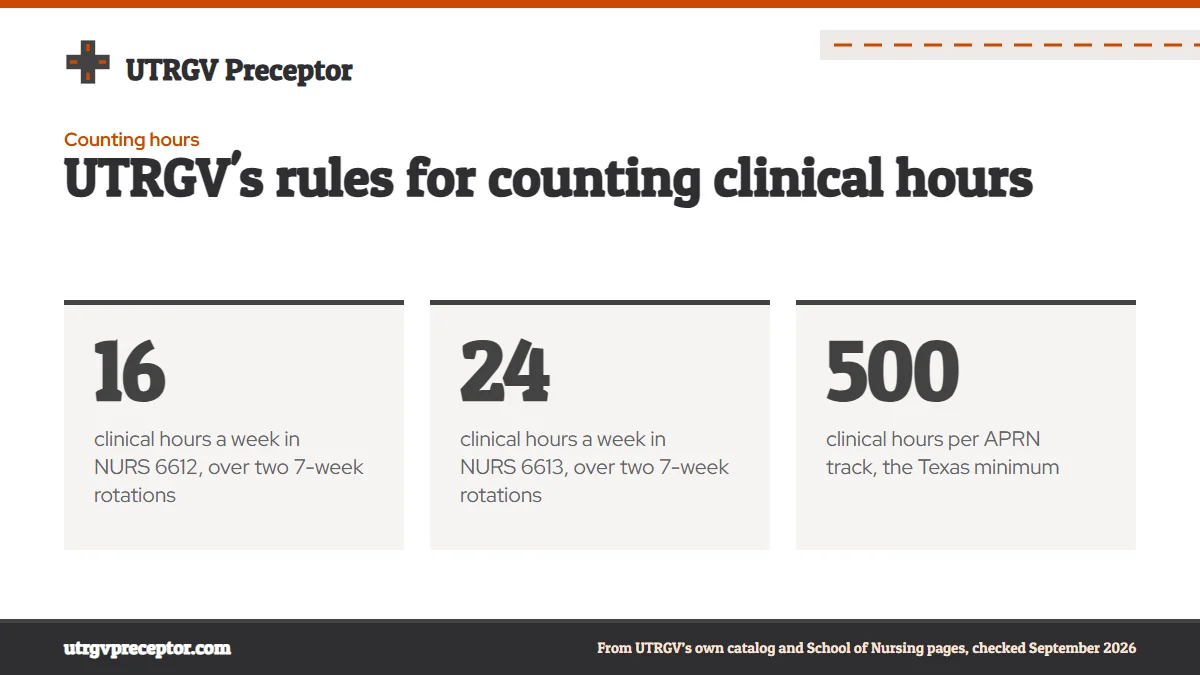
Finishing early needs the course coordinator's approval
The Fall 2025 NURS 6612 syllabus is direct about pace: "Completion of clinical hours ahead of time is not allowed unless there is a legitimate reason AND prior approval from the Course Coordinator is obtained." Both conditions apply. A good reason on its own is not enough, and the approval has to come before you speed up, not after.
The rule shapes the whole term. You cannot pile hours into the first rotation to clear space for a trip or an exam, and a preceptor who offers extra days early on is offering something you need permission to accept. If a real need comes up, such as planned surgery or a preceptor leaving the practice, put it in writing to your course coordinator before you change the schedule. UTRGV gives the course coordinator the same approval role in NURS 6613.
Each hour counts once
UTRGV's NURS 6310 and NURS 6311 syllabi put it plainly: "Clinical hours cannot count for another Clinical course in which you are currently enrolled." Texas's education rules rest on the same idea, asking for separate, non-duplicated clinical hours in each role and specialty. When two clinical courses overlap in one term, every hour on your log belongs to exactly one of them.
PMHNP certificate students meet a related limit. UTRGV's graduate FAQ, now removed and kept as an archived copy, answered no when asked whether clinical hours from a previous program, or any program, could count toward the certificate. Nurse practitioners who logged psychiatric hours somewhere else still begin the 520 at zero. How the overlap plays out term by term in the MSN is covered in NURS 6305, 6310 and 6311 hours.
Weekly hours in NURS 6612 and NURS 6613
The two FNP clinical courses set a weekly pace: 16 hours a week in NURS 6612 and 24 in NURS 6613, each spread over two 7-week rotations. Multiply either weekly figure by 14 weeks and you land exactly on the course total, which means the schedule has no spare week built in. The table sets out our arithmetic.
| Course | Hours a week | Per 7-week rotation | Over 14 weeks | Clinic days at 8 hours |
|---|---|---|---|---|
NURS 6612 | 16 | 112 | 224 | 2 a week |
NURS 6613 | 24 | 168 | 336 | 3 a week |
The 8-hour day is our planning example. The FNP I and II syllabi set weekly hours, and the only daily cap we found is the 8-hour limit in NURS 6347. A missed week leaves a gap that only extra hours later in the term can fill, so report any absence straight away; both courses ask you to notify all three of your clinical faculty. The course guides for NURS 6612 and NURS 6613 cover the rotations themselves.
Logs, signatures and the weekly time report
Hours are logged in Typhon, the tracking system each MSN student buys once, and PMHNP students log there as well. The clinical log grading criteria in NURS 6612 say a log is not accepted without weekly preceptor signatures or a preceptor evaluation, so have each week signed that week instead of chasing signatures at the end of the rotation.
FNP students also hand in the Mandatory Weekly Time Report at every Wednesday class. Because faculty visit sites at random, the report covers both the current week and the next one, which tells faculty where to find you. PMHNP students close out differently: the archived 2023-24 graduate guide has the student start a preceptor's letter verifying the supervised clinical clock hours once the practice experience ends, on a form kept in the PMHNP toolbox. Keep copies of every signed page until the course grade is posted.
Hours that count in less obvious ways
A few hours are defined by an activity or a setting instead of the clinic schedule. Each item below comes from a specific UTRGV document.
- Interprofessional activity:
NURS 6612credits a 4-hour Interprofessional Educational Activity with the School of Medicine or other health professions as clinical hours. - Operation Border Health: the Summer 2025
NURS 6347syllabus built this Texas DSHS event into the clinical assignment; the NURS 6347 guide has the details. - Daily cap:
NURS 6347allows no more than 8 clinical hours in a day, spread across at least two NP preceptors. - Telepsychiatry: the PMHNP limit is 75 of 520 hours in the archived FAQ and 220 in the Spring 2026
NURS 6620syllabus; telepsychiatry hours sorts out the conflict. - Children and adolescents: the archived PMHNP FAQ recommends about 120 hours with pediatric and adolescent patients, framed as advice for board preparation rather than a rule.
Hours alone do not pass a clinical course
Completing the hours is required but not sufficient. NURS 6612 and NURS 6613 each pass only when you finish every required hour and earn a satisfactory clinical preceptorship grade, regardless of your theory grade. A strong exam average cannot rescue a course with missing hours or a poor preceptor evaluation, and the preceptor's evaluation of you is one of the required end-of-course forms in NURS 6613.
Progression adds a second test. UTRGV's archived 2023-24 Graduate Nursing Student Guide says a student with a grade below B in any clinical course cannot progress in the program, and the catalog requires a cumulative graduate GPA of 3.0. The evaluations your preceptor and faculty complete feed directly into that grade, which is one more reason a well-matched preceptor matters. Grades and progression covers the details.
The Texas 500-hour floor
Texas Board of Nursing rules set a floor of 500 supervised clinical hours in each APRN track before licensure, directly related to the role and population focus. Chapter 219 of the rules adds that post-master's students complete at least 500 clinical hours and that clinical hours shall not be waived. That chapter is written around program approval, and neither UTRGV nor the Board says in public how directly it binds a CCNE-accredited program such as UTRGV's.
In practice UTRGV's own requirements sit above the floor in both NP programs, so meeting each course's figure keeps you clear of it. The no-waiver line is the one to remember: years of experience do not reduce the hours you log. The Board's preceptor and hour rules are set out in Texas BON preceptor rules.
How we keep your hours countable
Most hour problems start with the placement: a preceptor who can host 10 hours a week when the course needs 16, a site without an approved affiliation, or a second NP for NURS 6347 who never confirms. Our placement desk matches the preceptor's real clinic calendar to the course's weekly load before anything is signed, confirms the site is approved or starts the Clinical Request Form early, and keeps a backup preceptor in view.
We also walk your preceptor through what UTRGV expects each week, from log signatures to the time report, so nothing piles up at the end of a rotation. If you are already short on a course, behind on clinical hours has the next steps. If not, tell us your course and term in the form below.
Questions UTRGV students ask
Can I do extra clinical hours to finish NURS 6612 early?
Only with a legitimate reason and your course coordinator's approval given in advance. Without both, the syllabus does not allow it. Extra days a preceptor offers early in the term fall under the same rule, so ask before you accept them, and keep the approval in writing with your clinical records.
Can my PMHNP clinical hours be at the clinic where I work?
No. UTRGV's archived graduate FAQ says the practicum cannot be completed at your place of work, and the preceptor has to be a board-certified psychiatrist or an ANCC-certified PMHNP. Plan on a site other than your workplace from the start, and confirm the site with your clinical faculty before any hours begin.
What if my preceptor misses a week of log signatures?
Fix it that same week. The NURS 6612 log criteria say a log is not accepted without weekly preceptor signatures or a preceptor evaluation, so an unsigned week puts those hours at risk. Ask your preceptor to sign at the end of each clinic week, and tell your course coordinator promptly if a signature cannot be obtained.
Can UTRGV waive clinical hours for experienced nurses?
Texas rules say post-master's students complete at least 500 clinical hours and that clinical hours are not waived, and UTRGV's archived PMHNP FAQ refuses credit for hours from any earlier program. Experience helps you work faster with patients, but every required hour still has to be logged under an approved preceptor in the course.
Does the interprofessional activity replace clinic time in NURS 6612?
It counts for 4 of the 224 hours, as clinical hour credit for an interprofessional activity with the School of Medicine or other health professions. The other 220 come from precepted clinic time (our subtraction). Ask your course faculty early when the activity is scheduled, so your clinic days do not collide with it.
Related pages
Last checked 2026-09-27
We check these pages against UTRGV's own catalog, course syllabi, School of Nursing pages and Texas Board of Nursing rules. Your course faculty and the School of Nursing have the final word.
- UTRGV graduate catalog 2026-27: NURS 6612 Family Nurse Practitioner I
- UTRGV graduate catalog 2026-27: NURS 6311 Advanced Practice Rural Health Nursing
- UTRGV School of Nursing: Graduate Program FAQs (archived May 2025)
- UTRGV Graduate Nursing Student Guide 2023-2024 (archived)
- Texas Board of Nursing: rules and regulations, 22 TAC 219 and 221 (December 2024)
From the approved list or a brand-new site, we find the preceptor who fits.
Tell us your UTRGV program, where you live and when your next clinical course starts. We line up a willing preceptor who fits the course and UTRGV's rules, and hand you the details the Clinical Request Form, the affiliation agreement and the preceptor agreement ask for, well before the semester.
- Family practice preceptors for
NURS 6612andNURS 6613, and two NP sites forNURS 6347 - Board-certified psychiatric preceptors for
NURS 6476andNURS 6620, in your home state - Across the Valley and Texas, from McAllen and Brownsville to San Antonio, Houston and beyond
- A replacement lined up fast if a preceptor drops
Start your placement plan
Program, city and start date is all we need to begin.