Texas NP practice: delegation, agreements and your preceptors
Full practice authority is off the table for Texas nurse practitioners. A physician hands over prescribing through a written prescriptive authority agreement, and the medical side of an NP's care rests on that working relationship. For a UTRGV student, every Texas NP preceptor you meet prescribes under a physician's delegation, in clinics through such an agreement, and knowing its terms helps you choose preceptors and make sense of what you see in clinic.
Get your placement plan
Tell us your UTRGV program and where you live. A placement advisor replies with preceptor and site options in your community that fit your UTRGV course.
The rule in brief
The Texas Board of Nursing states in its APRN practice FAQ that APRNs do not hold full practice authority in Texas. Their scope can reach medical diagnosis and prescribing, but only when a physician properly delegates it, and the BON says the medical aspects of care require a collaborative relationship and practice agreement with a physician. The governing text sits in 22 TAC Chapter 222 and Chapter 157 of the Texas Occupations Code.
Section 222.5(a) calls the prescriptive authority agreement the tool a physician uses to hand an APRN the power to order and prescribe medicines and devices. Most of what follows on this page flows from that one signed document, which an outpatient NP preceptor in Texas holds with a named physician.
What every agreement must spell out
Section 222.5(c) sets the minimum contents. A valid agreement:
- Is in writing, signed and dated by the APRN and the physician.
- Gives each party's name and address and every professional license number each holds.
- Describes the kind of practice and its locations or settings.
- Lists the drug and device categories the APRN may prescribe, or instead the ones the APRN may not.
- Sets out a general plan for consultation and referral and a separate plan for patient emergencies.
- Explains how the two clinicians communicate and share information about the patients they treat.
- Names any alternate physicians who will fill in as delegating physician.
- Describes a quality assurance and improvement plan for prescribing, built on chart review (the pair decide how many charts) and periodic meetings, and says how the plan is documented.
Section 222.5(i) closes the door on side deals: a contract between the parties cannot waive or void any part of the rule or the matching Occupations Code sections.
Meetings, yearly review and the physician's cap
The periodic meetings must be documented and held at least monthly, in a way the physician and APRN agree on (§222.5(d)). According to the BON, House Bill 278 of 2019 ended the face-to-face requirement, so for agreements signed on or after September 1, 2019 the monthly meeting can happen by telecommunication.
The full agreement is reviewed, dated and re-signed at least once a year, and the parties must produce it to the BON, the Texas Medical Board or the Texas Physician Assistant Board by the third business day after one of them asks (§222.5(k)).
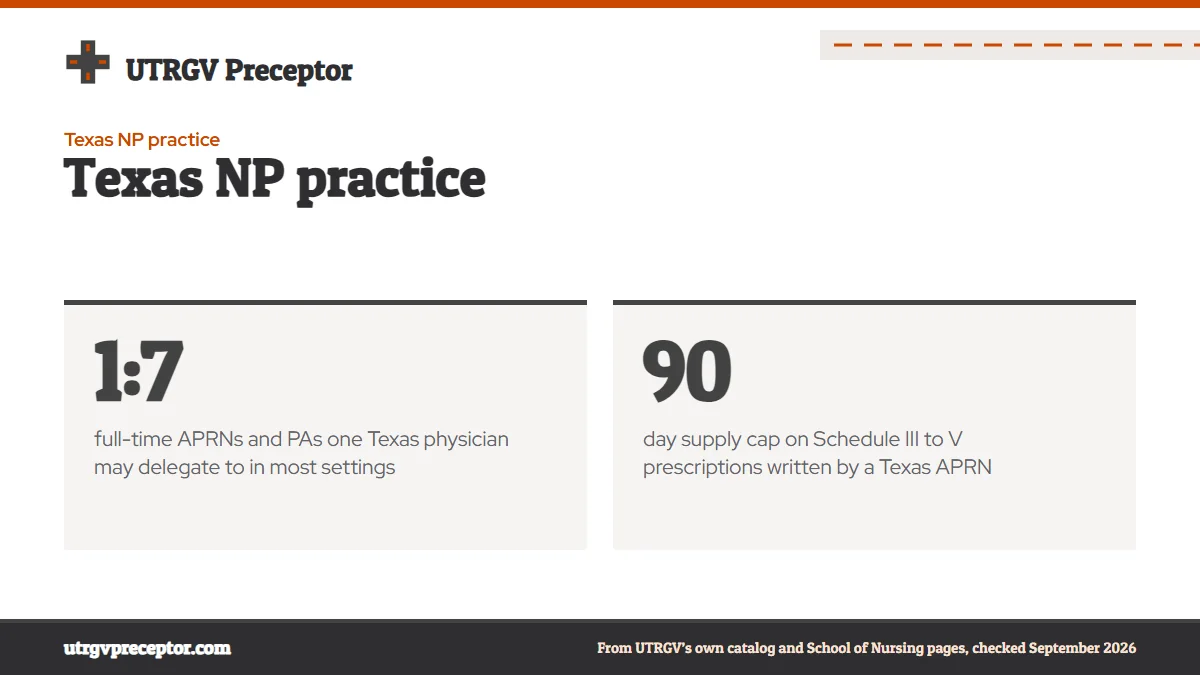
The BON's FAQ also caps delegation. In most settings one physician may delegate to at most seven full-time-equivalent APRNs and PAs combined, and no waiver is available. Facility-based hospital practices and practices serving medically underserved populations have no numeric cap. Each prescription carries the delegating physician's name, address and phone number, plus a DEA number for controlled substances, under Occupations Code §157.056 as the BON describes it.
Prescribing limits you will notice in clinic
Controlled substances are where delegation shows most plainly. Sections 222.6 and 222.8 set these limits:
| Situation | What the rule allows |
|---|---|
| Schedule II drugs | Only in a hospital facility-based practice, for a patient admitted for an intended stay of 24 hours or more or seen in the emergency department, or for a patient with a written terminal illness certification who has elected hospice care |
| Schedule III to V drugs | Up to a 90-day supply; refills past 90 days need consultation with the delegating physician, noted in the chart |
| Controlled substances for a child under two | Consultation with the delegating physician, noted in the chart |
| Hospitals and long-term care | Prescribing under an agreement, or through protocols or other written authorization set by the facility's medical staff policies |
So in a Valley family practice, your NP preceptor writes no Schedule II orders outside hospice care, and you will watch the 90-day limit and chart-noted consultations at work. That is real learning for NURS 6612 and NURS 6613, and it lines up with §221.3(i), which expects supervised clinical hours to include pharmacotherapeutic management of patients.
What delegation means for who can precept you
The FNP syllabi at UTRGV name three preceptor types: NP, PA and MD/DO. In a Texas practice, an NP preceptor always prescribes under a delegating physician, and that physician is also an eligible preceptor type for the FNP courses, which is worth knowing when you propose a practice to faculty. NURS 6347 is narrower and asks for master's-prepared NPs at two sites.
For the PMHNP courses, UTRGV sets the credential: either a psychiatrist holding ABPN board certification with over a year of post-residency practice, or an ANCC-certified PMHNP. DNP project preceptors are physicians and/or DNP-prepared APRNs. Preceptor requirements lists every rule, and Texas BON preceptor rules covers the state's definition of a qualified preceptor.
One detail shapes how we vet NPs: an RN practicing on interim approval as an APRN has no prescriptive authority (§222.2(a)). We look for preceptors with full APRN licensure and a current agreement, and we ask which drug categories the agreement covers, so the prescribing you learn from matches your course.
After graduation: your own agreement
The same rules will govern your first NP job. A prescription authorization number requires full APRN licensure from the BON, and interim approval does not qualify (§222.2(a)). You also show graduate coursework in advanced pharmacotherapeutics, advanced pathophysiology, advanced health assessment, and diagnosis and management; UTRGV's plan covers these through NURS 6306, NURS 6304, NURS 6305 and the FNP courses.
Then you and a physician sign an agreement that meets §222.5 before you write a prescription, and that physician's name goes on every prescription you issue, just as your preceptor's delegating physician appears on theirs. National certification and licensure steps are on NP certification exams, and RN license rules covers the license you hold now. Texas's compact membership covers RN and LVN licenses only; the APRN Compact has not been implemented there.
PMHNP students outside Texas
Texas's delegation model is one of several in the country. PMHNP certificate students train in their home state, where physician involvement can look quite different, and one assignment in the Spring 2026 NURS 6620 syllabus has students examine the level of physician oversight their state sets. PMHNP clinicals outside Texas covers the state side. In any state, the clinical faculty member assigned to you must clear the site before your hours start.
Wherever you live, we match PMHNP preceptors to the rules of that state and to UTRGV's board-certification requirement, and for Texas residents we confirm the preceptor's credential and prescribing arrangement before you commit. Tell us your course, your state and your start term, and we reply with a matching plan.
Questions UTRGV students ask
Can a nurse practitioner practice independently in Texas?
Not for the medical side of care. The BON says Texas APRNs lack full practice authority and need a collaborative relationship and practice agreement with a physician for medical aspects of care, diagnosis and prescribing among them. Prescriptive authority comes only through a signed prescriptive authority agreement that meets 22 TAC §222.5 and is reviewed at least yearly.
How many NPs can one Texas physician delegate to?
Outside facility-based hospital practice and practices serving medically underserved populations, the BON caps delegation at seven full-time-equivalent APRNs and PAs per physician, counted together, and it grants no waivers. In hospital facility-based practices and in practices serving medically underserved populations there is no numeric cap at all.
Do Texas NPs still have to meet their physician in person?
No. House Bill 278 (2019) removed the face-to-face meeting requirement. For agreements made on or after September 1, 2019, the APRN and physician meet at least monthly in a manner they choose, which can be by telecommunication, and each meeting is documented as part of the agreement's quality assurance plan.
Can a newly graduated NP on interim approval be my preceptor?
Texas bars RNs on interim approval from prescriptive authority, so such a clinician cannot model prescribing, and the state's qualified-preceptor definition asks for current practice in the advanced specialty. UTRGV faculty make the final call on any preceptor. We look for NPs with full APRN licensure and a current prescriptive authority agreement.
Does my preceptor's agreement limit what I learn to prescribe?
It shapes it. Each agreement lists the drug and device categories the NP may prescribe, or those excluded, and Schedule II limits apply outside hospitals and hospice. A family practice NP whose agreement covers everyday chronic-disease medicines gives broad exposure for the FNP courses, while a narrow specialty agreement gives less. Your faculty judge the fit.
Related pages
Last checked 2026-09-27
We check these pages against UTRGV's own catalog, course syllabi, School of Nursing pages and Texas Board of Nursing rules. Your course faculty and the School of Nursing have the final word.
- Texas Board of Nursing, APRN practice FAQ
- Texas Board of Nursing, Rules and Regulations (December 2024 compilation, 22 TAC Chapters 221 and 222)
- Texas Board of Nursing, Nurse Licensure Compact
- UTRGV Graduate Catalog 2026-27, NURS 6612 Family Nurse Practitioner I
- UTRGV Graduate Catalog 2026-27, NURS 6620 PMHNP 3: Clinical Therapeutics/Preceptorship
From the approved list or a brand-new site, we find the preceptor who fits.
Tell us your UTRGV program, where you live and when your next clinical course starts. We line up a willing preceptor who fits the course and UTRGV's rules, and hand you the details the Clinical Request Form, the affiliation agreement and the preceptor agreement ask for, well before the semester.
- Family practice preceptors for
NURS 6612andNURS 6613, and two NP sites forNURS 6347 - Board-certified psychiatric preceptors for
NURS 6476andNURS 6620, in your home state - Across the Valley and Texas, from McAllen and Brownsville to San Antonio, Houston and beyond
- A replacement lined up fast if a preceptor drops
Start your placement plan
Program, city and start date is all we need to begin.