UTRGV preceptor requirements, course by course
UTRGV sets a different preceptor rule for each program. FNP students train with qualified, approved NPs, PAs or physicians; NURS 6347 calls for two master's-prepared nurse practitioners; PMHNP students need a board-certified psychiatrist or PMHNP; and DNP projects use a physician or a DNP-prepared APRN. Below is each rule, the document it comes from, and the questions UTRGV leaves open.
Get your placement plan
Tell us your UTRGV program and where you live. A placement advisor replies with preceptor and site options in your community that fit your UTRGV course.
Who may precept each UTRGV course
Each row comes from the source that states the rule: mostly UTRGV's current public course syllabi and, for the PMHNP rule, the School of Nursing's graduate FAQ, now off the live site and read from a copy archived in May 2025. In every course, UTRGV faculty approve the site and the preceptor before any hour counts.
| Course | Who may precept | Extra conditions | Where it is stated |
|---|---|---|---|
FNP core: NURS 6305, NURS 6310, NURS 6311 (45 hours each) | A preceptor from UTRGV's approved list | NURS 6305: direct patient care in a primary care clinic | NURS 6305 syllabus, Spring 2026 |
NURS 6347 (45 hours) | Two or more master's-prepared NPs at two different sites | One student per preceptor; university-approved sites; 8 hours a day at most | NURS 6347 syllabus, Summer 2025 |
NURS 6612 (224 hours), NURS 6613 (336 hours) | Qualified and approved NPs, PAs or MDs/DOs | An affiliated site, or a new one through the Clinical Request Form | Syllabi, Fall 2025 and Spring 2026 |
PMHNP: NURS 6476, NURS 6620 | An ABPN-certified psychiatrist more than a year past residency, or an ANCC-certified PMHNP | Not your workplace; your state of residence; faculty clearance first | Graduate FAQ (archived May 2025) |
DNP: NURS 8211, NURS 8512 | A physician and/or a DNP-prepared APRN | Approved site; affiliation and preceptor agreements | NURS 8512 syllabus, Spring 2026 |
FNP courses: nurse practitioners, PAs or physicians
The two long FNP clinicals, NURS 6612 and NURS 6613, accept three professions: nurse practitioners, physician assistants, and physicians with an MD or DO. The syllabi describe these preceptors as "qualified and approved," and both words carry weight. The credential gets a clinician considered; approval comes from UTRGV, either because the preceptor already appears on the list in Brightspace or through faculty review after you submit them as a new preceptor.
Both courses sit in primary care. NURS 6612 covers common episodic and chronic problems in children and adults, and the catalog says NURS 6613 students take on more of the management as preceptors and faculty confirm their competence. An adults-only panel can meet the credential rule and still leave you short on pediatric patients, so match the practice to the course, not just the license. The NURS 6612 guide shows what that course expects.
NURS 6347: two nurse practitioners at two sites
The role course is the strictest FNP course. Its Summer 2025 syllabus asks for 45 hours with two or more nurse practitioners prepared at the master's level, each at a different clinical site, with no more than eight hours in a day. The rule names nurse practitioners only, not PAs or physicians, and it allows one UTRGV student per preceptor.
Sites must come from the university's approved list, a requirement the syllabus says is strictly followed, and the course coordinator signs off on your sites before the agreement goes in. That makes two preceptors, two schedules and two sets of paperwork inside a single summer term. Start lining both up early. Hours, dates and the Operation Border Health event are covered in the NURS 6347 guide.
PMHNP: a board-certified psychiatrist or PMHNP, never your workplace
The PMHNP rule is the narrowest in the School of Nursing. UTRGV's graduate FAQ allowed two kinds of preceptor and ended the answer with "No Exceptions":
- A psychiatrist holding American Board of Psychiatry and Neurology (ABPN) certification, with more than a year of practice since completing residency.
- A psychiatric mental health nurse practitioner holding ANCC board certification.
The same FAQ ruled out completing the practicum where you work and required a site in the state where you live, signed off by UTRGV's clinical advisors. The 2025-26 syllabi add the step that decides your first day: no clinical hours until your clinical faculty clears the preceptorship. Because the FAQ now survives only as an archive, confirm with your clinical faculty that the rule stands as written.
Whether UTRGV helps find this preceptor is a separate question with two public answers; see PMHNP placement assistance. The hours in each course are in the PMHNP practicum guide.
DNP projects: a physician or a DNP-prepared APRN
For the DNP, the preceptor rule appears in the title of a form. By Week 2 of NURS 8512, the Spring 2026 syllabus asks for a preceptor data sheet whose title names two kinds of preceptor, a physician or an APRN prepared at the DNP level, together with the preceptor agreement and student commitment and, if not filed earlier, the affiliation agreement forms. NURS 8211 is where the project goes live at an approved site, with 100 hours of clinical logs in its grade.
UTRGV does not publish who finds the DNP site or preceptor, a DNP practice-hour total, or any preceptor condition beyond the data sheet's two categories. Your DNP Project Faculty Advisors are the ones to ask, and the DNP project hours guide walks through the three project courses.
What Texas law adds
Texas defines a qualified preceptor for advanced practice nursing students in 22 TAC §219.2(19). The preceptor may be an advanced practice nurse, a physician or another health professional the Board of Nursing accepts, and must hold an active, unencumbered license, practice currently in the advanced specialty, support the advanced practice nurse role, and act as supervisor, teacher and evaluator of the student in the clinic.
Chapter 219 also expects written preceptor agreements, written criteria for choosing preceptors, and course objectives handed to the preceptor in advance. UTRGV's syllabi follow that pattern, though none of the documents read cites the chapter by number, and neither UTRGV nor the Board says whether it binds a nationally accredited program directly. The Texas BON preceptor rules guide has the full picture.
What UTRGV does not state
Some common questions have no public UTRGV answer. Where that is true, ask your course coordinator or clinical faculty before you commit a preceptor to a course.
- The state that must license the preceptor. UTRGV is silent on it. FNP clinicals take place in Texas in practice, and PMHNP sites are in the student's state of residence.
- A minimum number of years in practice for FNP preceptors. The only time floor UTRGV sets is the PMHNP psychiatrist's year past residency.
- Board certification from any organization other than the ABPN or the ANCC for PMHNP preceptors. The FAQ's wording covers those two only.
- The content of the preceptor orientation packet. The archived 2023-24 graduate guide required that every preceptor receive it before clinical work begins, but the packet itself stays inside Brightspace.
Being on UTRGV's approved list does not make a preceptor right for every course. A physician assistant who precepts you well in NURS 6612 still does not meet the nurse-practitioner-only rule in NURS 6347.
How we match a preceptor to UTRGV's rules
Our placement desk checks each candidate against the rule for your exact course before you hear a name.
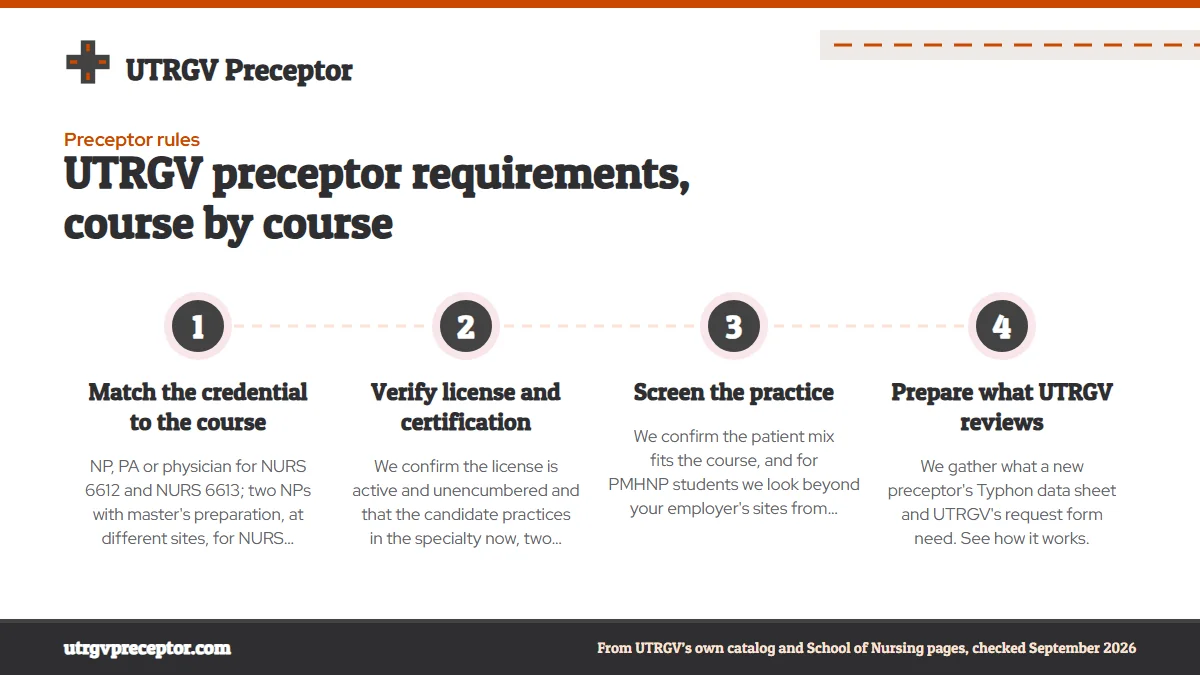
- Match the credential to the courseNP, PA or physician for
NURS 6612andNURS 6613; two NPs with master's preparation, at different sites, forNURS 6347; ABPN or ANCC certification for PMHNP; a physician or an APRN with a DNP for the DNP project. - Verify license and certificationWe confirm the license is active and unencumbered and that the candidate practices in the specialty now, two points in the Texas definition, and check board status for every PMHNP candidate.
- Screen the practiceWe confirm the patient mix fits the course, and for PMHNP students we look beyond your employer's sites from the start.
- Prepare what UTRGV reviewsWe gather what a new preceptor's Typhon data sheet and UTRGV's request form need. See how it works.
UTRGV faculty still approve every preceptor and site; our work is to put a candidate in front of them who already fits the rule. Send us your course and start date.
Questions UTRGV students ask
Does my UTRGV preceptor have to be licensed in Texas?
UTRGV publishes no rule on the preceptor's license state. The FNP program is campus-based in Edinburg and requires a Texas RN license, and its clinicals take place in Texas in practice, though no written rule says they must. PMHNP sites sit in your own state. Texas's definition asks for an active, unencumbered license. Clear any cross-border arrangement with your course faculty first.
Can a psychiatric nurse who is not board-certified precept a UTRGV PMHNP student?
Not under the rule in UTRGV's archived graduate FAQ, which named two options only, a psychiatrist with ABPN certification and over a year of post-residency experience or a PMHNP certified by the ANCC, and allowed no exceptions. An experienced but uncertified clinician, or a family nurse practitioner who treats many mental health patients, falls outside that wording. Raise any such candidate with your clinical faculty before investing time.
Can my own primary care provider be my FNP preceptor?
Look elsewhere. UTRGV's archived 2023-24 graduate guide said students should not turn to their faculty, preceptors or clinical sites for their own medical care, so a clinician who treats you is an awkward fit for a preceptorship. Your preceptor also has to evaluate you candidly at the end of the course, which is easier outside a patient relationship.
How many UTRGV students can one preceptor take?
The limit UTRGV states is in NURS 6347, where each preceptor may take one student. Texas separately limits faculty, not preceptors: one faculty member may oversee at most six students per clinical course. If a preceptor already hosts students from other schools, check that the practice can still give you the hours your course needs.
What does UTRGV need from a preceptor who is new to the School of Nursing?
Their details, on the right form. A preceptor not already on UTRGV's list goes on a Typhon data sheet, with separate versions for NPs, PAs and physicians, and a new site also needs the Clinical Request Form. Before the first day, the preceptor receives UTRGV's orientation packet. The agreement and forms guide explains each one.
Related pages
Last checked 2026-09-27
We check these pages against UTRGV's own catalog, course syllabi, School of Nursing pages and Texas Board of Nursing rules. Your course faculty and the School of Nursing have the final word.
- UTRGV graduate catalog 2026-27: NURS 6612 Family Nurse Practitioner I (Fall 2025 syllabus cited in text)
- UTRGV graduate catalog 2026-27: NURS 6347 Role Development for the Nurse Practitioner (Summer 2025 syllabus cited in text)
- UTRGV School of Nursing: Graduate Program FAQs (archived May 2025)
- UTRGV graduate catalog 2026-27: NURS 8512 DNP Project III (Spring 2026 syllabus cited in text)
- Texas Board of Nursing: rules and regulations, 22 TAC chapter 219 (December 2024)
From the approved list or a brand-new site, we find the preceptor who fits.
Tell us your UTRGV program, where you live and when your next clinical course starts. We line up a willing preceptor who fits the course and UTRGV's rules, and hand you the details the Clinical Request Form, the affiliation agreement and the preceptor agreement ask for, well before the semester.
- Family practice preceptors for
NURS 6612andNURS 6613, and two NP sites forNURS 6347 - Board-certified psychiatric preceptors for
NURS 6476andNURS 6620, in your home state - Across the Valley and Texas, from McAllen and Brownsville to San Antonio, Houston and beyond
- A replacement lined up fast if a preceptor drops
Start your placement plan
Program, city and start date is all we need to begin.