BSN clinicals at UTRGV: the courses, the assigned sites and what comes next
In UTRGV's campus BSN, the School of Nursing assigns your clinical agency, so your job is to be cleared, prepared and on time rather than to find a site. Eight clinical and skills courses run across four nursing semesters in Brownsville and Edinburg, and high-fidelity simulation covers part of the required time. This guide maps that sequence, the clearance items due before your first shift, and the steps that set you up for UTRGV's MSN-FNP later.
Planning ahead for graduate clinicals?
Tell us where you are in the BSN and when you hope to start the MSN-FNP.
Two campus routes, one clinical sequence
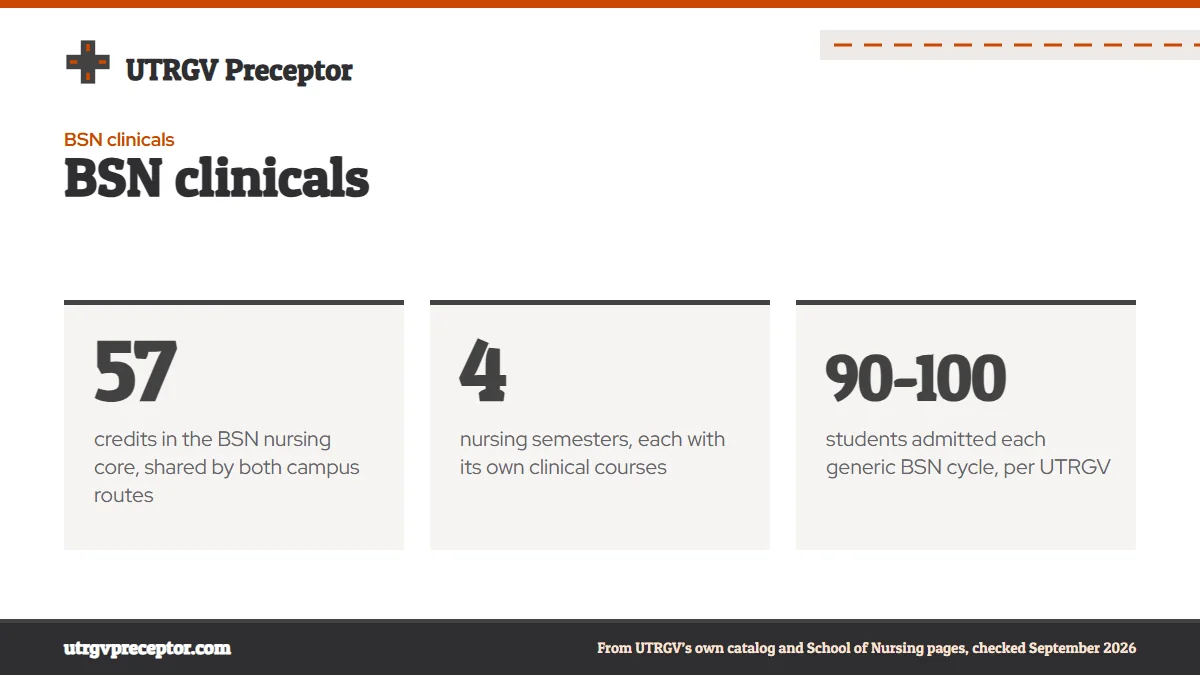
UTRGV teaches its campus BSN in two versions that share a 57-credit nursing core and the same clinical courses. Both mix face-to-face classes, campus labs and clinical labs inside hospitals, and both are coded for the Brownsville and Edinburg campuses.
| Route | Who it serves | Length | Starts | Admitted per cycle |
|---|---|---|---|---|
| Generic BSN | Students who do not yet hold a bachelor's | Four semesters (two years), enrolled continuously | Spring and fall | About 90 to 100 |
| ABSN | Students with a bachelor's in another field | Four consecutive semesters, which UTRGV also calls an accelerated 15-month program | Spring, summer and fall | About 30 to 40 |
ABSN is the name UTRGV's application checklist uses for the accelerated route; the catalog names it after the bachelor's its students already hold. One timing detail is worth checking: the School lists spring and fall starts for the generic BSN, while the 2026-27 roadmap enters the nursing courses in a fall term. The academic calendar page covers term dates.
Clinical courses, semester by semester
Each clinical course is a lab-type course in the 2026-27 undergraduate catalog, and the roadmaps place Nursing Semester 1 in the fall of Year 3. Here is where each one falls.
| Nursing semester | Course | Credits | Catalog focus |
|---|---|---|---|
| 1 | NURS 3304 Fundamentals of Nursing Clinical/Lab | 3 | Fundamentals and health care concepts, including the nursing process |
| 1 | NURS 3105 Client Assessment Lab/Skills | 1 | Assessment skills in a simulated setting |
| 2 | NURS 3311 Adult Health I Clinical | 3 | Care for two or more adults in a secondary health setting |
| 2 | NURS 3212 Mental Health Clinical | 2 | Clients with alterations in mental health |
| 3 | NURS 4301 Adult Health II Clinical | 3 | Adults in crisis or with complex health alterations |
| 3 | NURS 4305 Family Health Clinical | 3 | The perinatal cycle, newborns, infancy, childhood and adolescence |
| 4 | NURS 4202 Community Health Clinical | 2 | Individuals, families, communities and populations |
| 4 | NURS 4307 Leadership in Nursing Clinical | 3 | Leadership and management in clinical and lab settings |
Moving from one clinical semester to the next takes at least a C in each listed course from the semester before; grades and progression sets that beside the graduate rules. UTRGV publishes no hour count for any BSN clinical. One label can mislead when you read the schedule: NURS 4203 Pharmacology II carries the schedule type Practicum, yet it is an online pharmacology course, not a clinical.
Clinical agencies the School assigns
You do not choose your BSN clinical agency. UTRGV's Spring 2025 BSN Student Handbook, now archived, refers to the agency to which the student is assigned, and the School describes its clinical labs as taking place in local hospitals. Partner hospital names, shift patterns and hours per rotation are not published. The same handbook puts transportation to class, lab and clinical on the student, so budget time and fuel for wherever you are sent.
Community Health can take you beyond the hospital. UTRGV reported in October 2025 that students in NURS 4202 were getting up early on Saturdays to volunteer at a clinic in Peñitas.
Some of UTRGV's clinical partners ask students to use a placement platform such as My Clinical Exchange or CB-Bridges. The School's instruction is to register or pay only when your UTRGV clinical faculty tell you to. If you are assigned to a site that uses one, you may pay that platform's fee yourself.
Simulation and skills labs
Part of your required clinical time can happen in the simulation lab. UTRGV says it uses high-fidelity simulation in some courses in Edinburg and Brownsville to complete required clinical hours, and its simulation page cites the NCSBN's position that simulation can stand in for up to 50% of traditional clinical hours.
The scenarios come from the National League for Nursing and line up with the CoursePoint resources used in class. In your first nursing semester, NURS 3105 Client Assessment Lab/Skills runs beside NURS 3304 in a simulated setting, so your assessment skills are practiced in simulation alongside your first clinical days.
UTRGV does not publish which courses draw on simulation or how many hours it replaces in each. Your syllabus for each clinical course is the place to find that split.
Clearance before your first clinical
Conditionally admitted generic and ABSN students complete a list of requirements before admission becomes final. UTRGV's page for those students sets out these items:
- A DISA Healthcare compliance tracker, bought once for a package cost plus a service fee, which holds every document you upload
- A 10-panel drug test ordered through DISA
- A Texas BON background check through IdentoGo fingerprints, ending in a Blue Card or a positive outcome letter
- CPR as BLS for Healthcare Providers from the American Heart Association; American Red Cross and online-only cards are refused
- Immunizations: TB, hepatitis B (three doses, with titer rules), Tdap or Td, varicella, MMR and a yearly flu shot; COVID-19 is not a UTRGV requirement, though some facilities ask for it
- Professional liability insurance at the coverage level the page sets
Tracker documents may not expire before a semester starts, so renew ahead of each term. One line on the page still mentions uploading flu shots to CastleBranch, which looks like wording left over from an earlier vendor; treat DISA as the tracker and ask your clinical faculty if anything is unclear. Graduate students clear a different list, set out in the compliance checklist.
Getting ready now for UTRGV's MSN-FNP
If you picture yourself as a family nurse practitioner, the BSN years are a good time to line up the application quietly. UTRGV's MSN-FNP admits once a year for fall and teaches its FNP courses on the Edinburg campus.
Steps you can take during the BSN
- Pass the NCLEX and hold an unencumbered Texas RN license, which the MSN-FNP requires at admission and for the whole program
- Finish an undergraduate statistics course if your plan does not already include one
- Get to know faculty and nurse leaders who could write the three letters of recommendation the MSN asks for
- Keep immunization and background records organized, since graduate clinicals need the School's immunization form and a cleared background check
- Pay attention to the nurse practitioners, physician assistants and physicians you meet on the units; UTRGV's FNP syllabi accept all three as preceptors
The big change at the graduate level is who arranges clinicals. UTRGV's current FNP syllabi put lining up preceptors on the student, working from a UTRGV-approved list or requesting a new site. The MSN-FNP guide covers the program, and finding a preceptor shows what a strong match looks like.
Where our placement desk fits
BSN clinical sites belong to the School to assign, and that arrangement serves undergraduate students well. Our work starts with graduate clinicals, where finding the right preceptor becomes your task: when you begin UTRGV's MSN-FNP, your placement advisor finds willing preceptors for each course, checks them against UTRGV's rules and prepares the details UTRGV's approval steps need.
Planning early pays off because the first precepted hours arrive in the first MSN year. If you are a BSN student looking ahead, or an RN finishing the RN to BSN, send your timeline through the placement request form and choose BSN or RN to BSN. Your placement advisor will map which FNP courses need preceptors and when, from the NP, PA or physician most FNP courses accept to the two master's-prepared nurse practitioners at two sites that NURS 6347 asks for.
Questions UTRGV students ask
Can I pick my own clinical site in UTRGV's BSN?
No. BSN clinical agencies come from the School, and UTRGV's handbook language speaks of the agency a student is assigned to. If you have a strong reason to ask for a particular area or schedule, raise it with your clinical faculty or the BSN program coordinator, knowing the final assignment is theirs to make.
How many clinical hours are in UTRGV's BSN?
UTRGV publishes neither a total nor a per-course figure. The catalog describes each clinical course only by credits and schedule type, and part of the required time can come from high-fidelity simulation. Each course's syllabus and your clinical faculty set the hours, so check the course documents in Brightspace at the start of every term.
Does the ABSN have the same clinicals as the generic BSN?
As far as the catalog shows, yes. Both routes share the 57-credit nursing core, so the same eight clinical and skills courses appear in each, and the roadmap campus codes match. The ABSN fits them into four consecutive semesters over about 15 months, with three starts a year, so its clinical sequence runs through a summer term as well.
Can a BSN clinical agency later host my FNP clinicals?
Possibly, but it is not automatic. UTRGV does not say whether an agency's undergraduate agreement also covers graduate students, and FNP sites must be approved before hours start. A clinician who knows your work is easier to ask, so note good contacts now, then check with your FNP course faculty whether that organization is on UTRGV's approved list.
When are UTRGV BSN applications due for 2027 and 2028 starts?
For the generic BSN, Fall 2027 applications run November 1, 2026 to January 8, 2027, and Spring 2028 runs April 1 to May 31, 2027. For the ABSN, Summer 2027 runs September 1 to October 31, 2026, Fall 2027 runs December 1, 2026 to January 31, 2027, and Spring 2028 runs May 1 to June 30, 2027. All applications go through NursingCAS.
Related pages
Last checked 2026-09-27
We check these pages against UTRGV's own catalog, course syllabi, School of Nursing pages and Texas Board of Nursing rules. Your course faculty and the School of Nursing have the final word.
- UTRGV Undergraduate Catalog 2026-27: Nursing, Bachelor of Science in Nursing
- UTRGV School of Nursing: undergraduate programs
- UTRGV School of Nursing: when and how to apply (cycles and cohort sizes)
- UTRGV School of Nursing: requirements for conditionally admitted generic and ABSN students
- UTRGV School of Nursing: simulation lab and high-fidelity manikins
From the approved list or a brand-new site, we find the preceptor who fits.
Tell us your UTRGV program, where you live and when your next clinical course starts. We line up a willing preceptor who fits the course and UTRGV's rules, and hand you the details the Clinical Request Form, the affiliation agreement and the preceptor agreement ask for, well before the semester.
- Family practice preceptors for
NURS 6612andNURS 6613, and two NP sites forNURS 6347 - Board-certified psychiatric preceptors for
NURS 6476andNURS 6620, in your home state - Across the Valley and Texas, from McAllen and Brownsville to San Antonio, Houston and beyond
- A replacement lined up fast if a preceptor drops
Start your placement plan
Program, city and start date is all we need to begin.